
Corner cabinets are notorious for becoming black holes in the kitchen or bathroom, where Tupperware lids, seldom-used appliances, and mystery containers go to disappear. The awkward depth and blind angles make accessing items difficult, and precious square footage gets wasted. But with the right storage solutions, that dead space transforms into highly functional real estate. This guide walks through proven systems, from classic lazy Susans to modern pull-out shelves, that make corner cabinets work harder, along with DIY options for homeowners on a budget.
Table of Contents
ToggleKey Takeaways
- Corner cabinet storage solutions like lazy Susans and pull-out shelves transform wasted space into functional storage by addressing the geometry and accessibility challenges of standard cabinet designs.
- Lazy Susan systems work best for smaller items like spices and baking supplies, while blind corner pull-outs are ideal for frequently used cookware and pantry staples in base cabinets.
- Pull-out shelving systems cost $150–$300 but provide superior accessibility and handle heavier loads better than rotating trays, making them valuable for users with limited mobility.
- Budget-friendly DIY options including stackable bins, tension rods, and custom plywood shelves deliver functional improvements without specialized hardware or installation expertise.
- Accurate measurement and door configuration assessment are critical before selecting a corner cabinet solution, as cabinet size, hinge type, and weight capacity determine which system works best.
Why Corner Cabinets Are So Challenging to Organize
The problem with corner cabinets isn’t just the geometry, it’s how standard cabinet designs ignore human reach and sightlines. Most base corner cabinets feature a 90-degree intersection where two cabinet runs meet, creating a deep, angular void that extends 24 inches or more into the corner. Without specialized hardware, anything stored past the first 12 inches becomes invisible and inaccessible.
This wasted space is further complicated by the cabinet door swing. Traditional hinged doors block access to one side of the interior while open, forcing users to crouch, reach blindly, and shuffle items around just to retrieve a single pot. Upper corner cabinets share the same issues but add the challenge of overhead reach, making them even less practical for everyday storage.
The result? Homeowners either avoid using corner cabinets entirely or stuff them with items they rarely need, both of which sacrifice valuable kitchen storage. Addressing this requires purpose-built systems designed specifically for corner geometry, not just standard shelves wedged into an awkward space.
Lazy Susan Systems for Easy Access
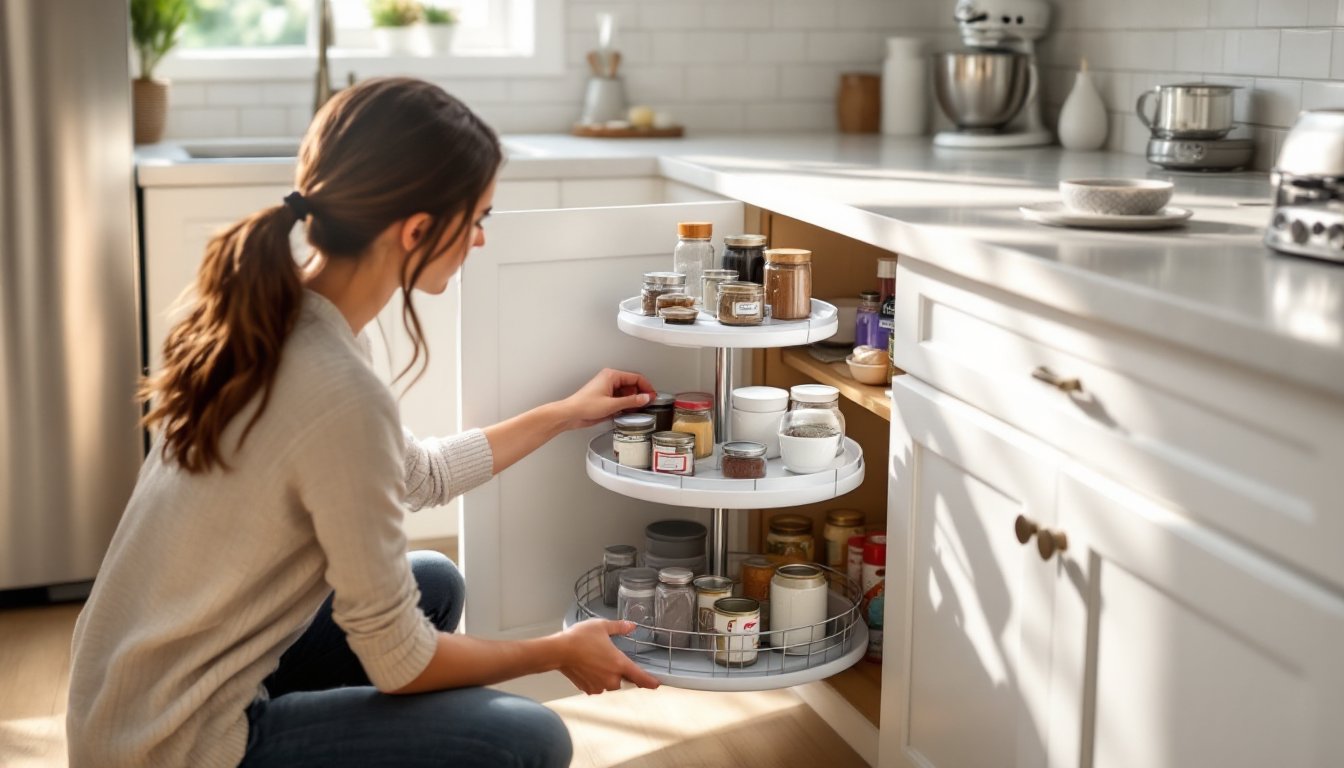
The lazy Susan remains the most popular corner cabinet solution because it’s simple, reliable, and brings everything within reach with a quick spin. These circular rotating trays mount to a central pole and pivot smoothly, eliminating the need to dig into dark corners.
Two main types dominate the market: full-round lazy Susans and kidney-shaped (half-moon) models. Full-round units work best in cabinets with wide openings and minimal door interference, typically 33 inches or larger. Kidney-shaped versions are designed for standard corner cabinets where door hinges and frame rails intrude into the interior, these units have a cut-out section that clears the obstruction as they rotate.
When installing a lazy Susan, precise measurement is critical. Most units require a minimum clearance of 2 inches from the cabinet walls to rotate freely. The trays should sit level: even a slight tilt causes items to slide during rotation. Polymer trays are more durable and quieter than wire models, and they won’t rust in humid environments.
One common complaint: items can slide off during rotation, especially lightweight boxes or bottles. Adding raised edges or containment rails solves this issue. Some aftermarket kits include adjustable dividers that secure items in place.
Lazy Susans aren’t ideal for storing tall or bulky items like small appliances, these create dead zones on the tray and limit what else fits. They shine for canned goods, spices, baking supplies, and mixing bowls. Installation typically requires only a drill and screwdriver, and most units retrofit into existing cabinets without modification.
Pull-Out Shelves and Drawers That Bring Items to You
Pull-out shelving systems eliminate the reach-and-fumble problem by extending the entire contents of the cabinet toward the user. These systems use heavy-duty drawer slides rated for 75–100 pounds and mount to the cabinet floor or side walls, allowing shelves to glide out on ball-bearing tracks.
For corner cabinets, specialized blind corner pull-out units are the go-to solution. These consist of a lead tray that pulls straight out, which then triggers a second tray to swing out from the blind corner section. The design brings items from the deepest part of the cabinet into full view and easy reach. Brands like Rev-A-Shelf and Hafele manufacture these units in various widths to fit standard cabinet openings from 12 to 18 inches.
Installation requires more precision than a lazy Susan. The cabinet door must clear the extended shelves, which sometimes means adjusting or replacing hinges with soft-close European-style models. The pull-out mechanism needs solid mounting, particle board cabinet floors may require reinforcement with plywood backing to handle the weight and repeated motion.
Another option is two-tier pull-out baskets, which work well in upper corner cabinets. These wire or mesh baskets slide out independently, offering visibility and airflow, ideal for storing snacks, produce, or cleaning supplies. They typically mount to the cabinet sides using L-brackets and wood screws.
Pull-out systems cost more upfront than lazy Susans, expect to spend $150–$300 per unit depending on size and quality, but they handle heavier loads and provide superior accessibility for users with limited mobility. They’re especially valuable in kitchens where corner cabinets store frequently used cookware or pantry staples.
Swing-Out and Tiered Organizers for Maximum Visibility
Swing-out shelving takes a different approach by attaching shelves directly to the cabinet door. When the door opens, shelves pivot out of the cabinet interior, exposing items stored in the back corner. This system works particularly well in base corner cabinets where door swing is generous and there’s enough clearance for the mechanism to operate.
These units typically feature two or three shelves mounted to a single swing arm. As the door opens, the shelves arc outward in a smooth motion, bringing corner contents into plain sight. Some models include a second set of fixed shelves in the cabinet that remain stationary, effectively doubling storage capacity.
Installation is more involved than other systems. The swing mechanism must align precisely with the door hinge centerline, and the cabinet door may need reinforcement to handle the added weight, especially if storing canned goods or small appliances. Most swing-out kits include metal mounting plates that distribute load across the door frame.
Tiered organizers are a simpler alternative for upper corner cabinets. These are stepped shelving units, often plastic or coated wire, that create levels within the cabinet space. Items in the back sit higher than those in front, making labels and contents visible at a glance. They’re ideal for spice jars, vitamins, or baking ingredients.
Both swing-out and tiered systems require regular adjustment. Hinges and pivot points can loosen over time, especially with heavy use. Check mounting screws quarterly and tighten as needed. Always use safety glasses when drilling into cabinet frames, splinters and metal shavings are common.
Creative DIY Corner Cabinet Solutions on a Budget
Not every corner cabinet problem requires a $200 hardware kit. Several DIY approaches deliver functional improvements using basic materials and tools most homeowners already own.
Stackable bins and turntables are the simplest fix. Inexpensive plastic lazy Susans (the kind without mounting hardware) sit directly on the cabinet floor and cost $10–$20. Pair them with clear stackable bins to group similar items, one turntable for baking supplies, another for oils and vinegars. Label bins with a marker or label maker for quick identification.
For taller corner cabinets, install tension rods vertically to create dividers for baking sheets, cutting boards, and serving trays. Measure the interior height, cut the rod to size, and wedge it into place. This keeps flat items upright and accessible instead of piled in a toppling stack.
Another budget option: custom plywood shelves cut to fit the exact dimensions of the corner. Use a jigsaw to notch the back corner (where cabinet walls meet) and create an L-shaped or pie-shaped shelf. Sand edges smooth, apply polyurethane or paint for durability, and mount with L-brackets or shelf pins. This approach works especially well for pantry cabinets where weight loads are moderate.
Pegboard inserts transform vertical corner space into customizable storage. Cut a piece of 1/4-inch pegboard to fit the cabinet back wall, paint it to match, and mount it with spacers (small wooden blocks or standoffs) so hooks have clearance. Hang mugs, utensils, or small baskets, and rearrange as needs change.
All DIY solutions share one requirement: accurate measurement. Corner cabinets have irregular dimensions, and off-the-shelf organizers rarely fit without modification. Measure width, depth, and height at multiple points, cabinets aren’t always square, and plan cuts accordingly. Wear dust masks when cutting MDF or particleboard, as both materials produce fine, irritating dust.
Choosing the Right Storage Solution for Your Space
Selecting the best corner cabinet system depends on cabinet size, door configuration, budget, and what’s being stored. There’s no universal solution, but a few guidelines help narrow the field.
For base corner cabinets with limited door openings (less than 15 inches): Blind corner pull-outs or kidney-shaped lazy Susans are the most practical choices. Full-round lazy Susans won’t clear the door frame, and swing-out units need wider access.
For upper corner cabinets: Tiered organizers or small lazy Susans work best. These cabinets typically store lighter items, spices, vitamins, coffee supplies, that don’t require heavy-duty hardware. Avoid pull-out systems in uppers unless door swing and ceiling clearance allow full extension.
For renters or temporary solutions: Stick with non-permanent options like stackable bins, freestanding turntables, or tension rods. These require no drilling and can move with the homeowner.
For high-use cabinets storing cookware or appliances: Invest in pull-out shelving. The upfront cost is justified by daily convenience and durability. Lazy Susans work but can become cluttered quickly with bulky items.
Before buying any system, remove the cabinet door and measure the interior with a tape measure. Note any obstructions, water supply lines, electrical outlets, or uneven walls, that might interfere with installation. Check door hinge type: older cabinets with wraparound hinges may need adapter plates for modern hardware.
If the cabinet is structural or load-bearing (rare but possible in older homes), consult a contractor before drilling into cabinet frames or walls. Most corner cabinet upgrades are cosmetic and safe for DIY installation, but it’s worth confirming.
Conclusion
Corner cabinets don’t have to be wasted space. Whether it’s a classic lazy Susan, a heavy-duty pull-out system, or a DIY pegboard insert, the right solution brings order to awkward corners and puts every inch to work. Measure carefully, match the system to what’s being stored, and don’t skip the installation details, loose hardware and misaligned tracks cause more frustration than the original clutter.