

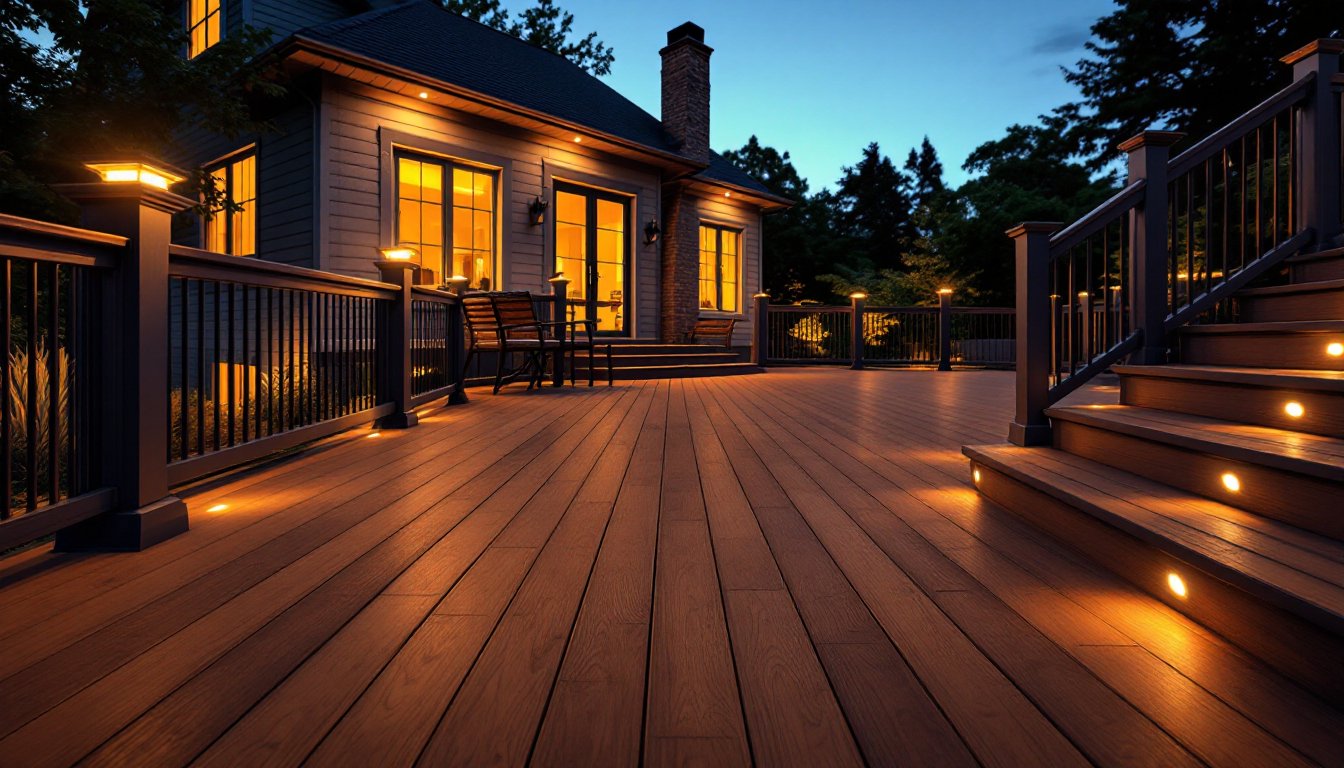
Composite decking has revolutionized outdoor living spaces with its durability and low maintenance, but without proper lighting, even the best deck becomes a dark, underutilized space after sunset. Composite outdoor lighting transforms a deck from a daytime-only area into a safe, functional, and inviting environment for evening gatherings, late-night grilling, or simply enjoying a quiet night under the stars. Unlike traditional wood decking where fixture placement requires careful moisture considerations, composite materials integrate seamlessly with modern low-voltage LED systems designed specifically for synthetic decking profiles. This guide walks through everything a homeowner needs to know about lighting options, installation considerations, and choosing the right system for their composite deck.
Table of Contents
ToggleKey Takeaways
- Composite outdoor lighting transforms underutilized decks into safe, functional evening spaces by integrating low-voltage LED systems designed specifically for synthetic decking materials like Trex and TimberTech.
- Proper deck lighting prevents trips and falls on stairs and transitions, extends usable outdoor hours across seasons, and can increase property value—a significant return on the $800–$2,500 investment for a complete system.
- Post cap lights, recessed deck lights, and riser lights serve distinct purposes; most effective composite deck lighting plans combine multiple types to balance ambient, task, and safety lighting.
- Low-voltage 12V or 24V systems are safer for DIY installation than line-voltage alternatives, consume minimal energy (typical systems use less than 60 watts), and offer smart home integration for automation and control.
- Success requires calculating transformer capacity by adding fixture wattage and multiplying by 1.2 for voltage drop, matching fixtures to your specific railing system, and planning wire routing through joist bays before installation to avoid visibility issues.
What Is Composite Outdoor Lighting and Why Does It Matter?
Composite outdoor lighting refers to illumination systems specifically designed to integrate with composite decking materials, products like Trex, TimberTech, Fiberon, and similar PVC or wood-polymer blends. These lighting fixtures account for the unique properties of composite materials: they don’t split like wood, they expand and contract differently with temperature changes, and many feature hollow or grooved understructures that accommodate wiring channels.
The “why” goes beyond aesthetics. Safety tops the list, proper lighting prevents trips and falls on stairs, transitions, and deck edges, especially critical since composite surfaces can become slippery when wet. The International Residential Code (IRC) doesn’t mandate deck lighting in most jurisdictions, but it does require guardrails on elevated decks, and illuminating those barriers prevents accidents.
Lighting also extends the usable hours of outdoor space. A deck represents a significant investment, often $15,000 to $30,000 for a mid-sized composite build, and leaving it dark after 8 PM wastes that investment half the year. Finally, integrated lighting systems can increase property value. Outdoor living features consistently rank high with homebuyers, and professionally lit decks photograph well and demonstrate attention to detail.
Modern composite lighting systems run primarily on 12-volt or 24-volt DC power, stepped down from household current through a transformer. This low-voltage approach is safer for DIY installation than line-voltage (120V) systems and falls outside electrical permit requirements in many areas, though it’s always wise to check local codes before running new circuits.
Types of Composite Deck Lighting Options
Composite deck lighting breaks into three main categories, each serving distinct functional and design purposes. Most comprehensive lighting plans combine two or more types.
Post Cap Lights
Post cap lights sit atop 4×4 or 6×6 railing posts, casting ambient light downward and outward across the deck surface. They’re the most visible lighting element and often serve double duty as decorative accents. Most composite railing systems include post caps designed to accept low-voltage lighting inserts, verify compatibility before purchasing.
These fixtures typically house 1.5 to 3-watt LED modules producing 30 to 60 lumens. That’s enough to define deck perimeters and create a soft glow without overpowering conversation areas. Installation is straightforward: the wiring runs down through the hollow post (most composite posts are designed for this), connects to a main line beneath the deck, and the cap simply friction-fits or screws onto the post top.
Solar post caps eliminate wiring entirely but come with tradeoffs. Battery life degrades after 2-3 years, light output is weather-dependent, and they can’t be controlled by a central timer or smart switch. They work well for remote sections where running wire is impractical.
Recessed Deck Lights
Recessed deck lights (sometimes called flush-mount or puck lights) install directly into the deck surface or railing, sitting flush to prevent tripping hazards. They’re workhorses for task lighting, illuminating cooking areas, seating zones, or pathways.
Installation requires cutting precise holes in composite boards, typically 2 to 3 inches in diameter. Use a hole saw with a fine-toothed blade to prevent chipping: composite materials can fracture if drilled too aggressively. Most recessed fixtures include a waterproof housing that fits into the hole, with the LED module snapping into place from above.
Spacing depends on light output and purpose. For pathway lighting along a deck edge, position fixtures every 4 to 6 feet. For focused task lighting over a grill or bar area, cluster 2-3 fixtures closer together. Remember: composite decking boards have hollow chambers running lengthwise, plan wire routing to follow those channels or run beneath the deck through joist bays.
Riser and Step Lights
Stair lighting isn’t optional on multi-level decks, it’s a safety necessity. Riser lights mount vertically on stair faces, while step lights can recess into tread noses. Both prevent missteps that account for the majority of deck-related injuries.
The IRC requires stair treads of at least 10 inches deep (measured horizontally) and risers no higher than 7¾ inches. Lighting one fixture per step is standard practice, positioned either centered on the riser or offset to one side for a contemporary look. Horizontal riser lights (rectangular fixtures spanning 6 to 12 inches) provide better illumination across the full tread width than centered puck lights.
Wiring riser lights during deck construction is vastly easier than retrofitting. If building new, run low-voltage cable through or alongside the stair stringers before installing treads and risers. For retrofit installations on existing composite stairs, surface-mount fixtures with concealed wire channels offer a cleaner look than exposed conduit.
Benefits of Installing Composite Deck Lighting
Beyond the obvious safety improvements, composite deck lighting delivers several practical advantages that justify the investment, typically $800 to $2,500 for a complete low-voltage system on an average-sized deck.
Extended seasonal use matters more than many homeowners initially realize. In northern climates, summer sunsets arrive after 9 PM, but spring and fall evenings darken by 7 PM. Lighting pushes outdoor entertaining and relaxation into those shoulder seasons when weather is still pleasant but daylight is limited.
Energy efficiency is a given with modern LED systems. A typical 20-fixture deck lighting system draws 40-60 watts total, less than a single incandescent bulb. At $0.13 per kWh (the 2026 national average), running lights 4 hours nightly costs about $3 per month. LED modules in quality fixtures are rated for 50,000+ hours, meaning 10-15 years of maintenance-free operation under normal use.
Low-voltage safety makes DIY installation feasible for homeowners with basic electrical knowledge. While the transformer connecting to household 120V current should be installed by a licensed electrician (or with a permit), the 12V/24V deck-side wiring poses minimal shock risk. Wire connections use simple twist-on caps or proprietary snap connectors, no wire nuts or junction boxes required.
Aesthetic enhancement separates a basic deck from a designed outdoor room. Uplighting posts, grazing light across textured composite surfaces, or silhouetting planters and furniture creates depth and visual interest. Warm white LEDs (2700K-3000K color temperature) complement the earth tones of most composite decking: cooler whites (4000K+) can look sterile in residential settings.
Smart home integration is increasingly standard. Many low-voltage transformers now include Wi-Fi connectivity for smartphone control, scheduling, and dimming. Compatibility with Alexa, Google Home, or Apple HomeKit lets homeowners automate lighting based on sunset times or integrate deck lights into whole-home scenes.
How to Choose the Right Lighting for Your Composite Deck
Selecting a lighting system starts with assessing the deck’s purpose, size, and existing electrical infrastructure. Walk through these considerations before purchasing fixtures.
Prioritize based on use. A deck primarily for dining needs task lighting over the table and grill area. A deck for lounging benefits from softer ambient post cap lights and perhaps uplighting on planters or railings. High-traffic stairs always demand dedicated step lighting, don’t skimp here.
Calculate transformer capacity. Add up the wattage of all planned fixtures, then multiply by 1.2 to account for voltage drop over wire runs. That’s the minimum transformer capacity needed. Low-voltage transformers come in 100W, 200W, 300W, and larger sizes. A 200W transformer adequately powers 40-60 typical deck lights depending on distance from the transformer. Position the transformer as centrally as possible to minimize wire runs, every 100 feet of 12-gauge wire in a 12V system loses about 2 volts, dimming distant fixtures.
Match the lighting system to the deck railing. If the deck uses a branded composite railing system (Trex Transcend, TimberTech RadianceRail, etc.), the manufacturer likely offers purpose-built lighting designed to integrate with those posts and rails. While universal fixtures work, system-specific products install faster and look more cohesive.
Consider color consistency. LEDs vary slightly in color temperature even within the same product line. Buying all fixtures from one manufacturer in a single order reduces the chance of noticeable color mismatches. Look for products listing a CRI (Color Rendering Index) of 80 or higher, this ensures colors of furniture, plants, and finishes appear natural rather than washed out.
Check IP ratings for weather resistance. Outdoor lighting should carry at least an IP65 rating (dust-tight, protected against water jets). Fixtures installed in deck surfaces or exposed to direct rain need IP67 (submersion-resistant). Lower ratings might work under covered areas but won’t survive a decade of weather exposure.
Plan wire routing before installation. Composite decking installation typically involves running boards perpendicular to joists spaced 12 or 16 inches on center. Low-voltage wire can run through joist bays beneath the deck surface, emerging where fixtures mount. Use outdoor-rated 12-gauge or 14-gauge wire, the lower number handles longer runs with less voltage drop. Avoid stapling wire to joists where it might be punctured: use plastic clips or route through drilled holes.
If retrofitting lighting to an existing deck, surface-mount wire channels or routing wire through railing systems may be necessary. Some composite railing systems include grooved bottom rails specifically for concealing lighting wire, check the installation manual.