
Most commercial properties go dark after sunset, losing curb appeal and security the moment the sun dips below the horizon. Professional landscape lighting changes that equation entirely, boosting visibility, extending business hours perception, and creating a memorable impression that sets a property apart from competitors. Whether it’s a restaurant patio, office campus, retail center, or hospitality venue, strategic outdoor lighting turns underutilized nighttime real estate into an asset. This guide walks through the core principles, techniques, and practical considerations for designing commercial landscape lighting that delivers both function and visual impact.
Table of Contents
ToggleKey Takeaways
- Commercial landscape lighting design enhances security, curb appeal, and property value by transforming underutilized nighttime exteriors into functional and visually appealing assets.
- Effective lighting uses three-layer approach: ambient light for safe navigation, task light for functional zones, and accent light for visual interest and architectural drama.
- Color temperature selection (warm 2700K–3000K for hospitality, neutral 3500K–4100K for offices, cool 5000K+ for security) dramatically affects both mood and visibility in commercial settings.
- LED fixtures deliver superior efficacy, 50,000+ hour lifespan, and dimming capabilities that reduce operating costs and light pollution compared to legacy halogen and HID technologies.
- Professional planning with photometric analysis, site surveys, and permit review prevents costly rework and ensures commercial landscape lighting projects meet code requirements and client objectives.
Why Commercial Landscape Lighting Design Matters for Your Business
Commercial landscape lighting does more than illuminate walkways. It reinforces brand identity, increases property value, and addresses liability concerns tied to poorly lit exteriors.
Security tops the list for most property managers. Well-lit perimeters, entrances, and parking areas deter theft and vandalism while reducing slip-and-fall claims. Insurance providers often recognize adequate exterior lighting as a risk-mitigation measure.
Curb appeal after dark extends the marketing window. A restaurant with ambient patio lighting or a retail complex with architectural accent lights projects success and attracts evening traffic. Properties that go black at night signal closure, even when they’re open.
Code compliance can’t be ignored. Many jurisdictions require minimum footcandle levels for parking lots, walkways, and building entrances under International Building Code (IBC) and local amendments. Consult local building departments early, retrofitting lighting to meet code after installation is costly.
Finally, energy-efficient LED systems reduce operating costs. Commercial-grade LEDs often deliver 50,000+ hours of life with minimal lumen degradation, cutting maintenance cycles and electricity bills compared to legacy metal halide or high-pressure sodium fixtures.
Key Elements of Effective Commercial Landscape Lighting
Good commercial lighting design balances visibility, aesthetics, and energy consumption. Two foundational concepts separate amateur setups from professional systems: layering and technical specification.
Layering Light for Depth and Drama
Single-source lighting flattens landscapes and creates harsh shadows. Effective designs use three layers:
- Ambient light provides general illumination, typically pathway lights, overhead canopy fixtures, or area floods that meet minimum code requirements for safe navigation.
- Task light focuses on functional zones: building entries, signage, loading docks, or outdoor seating areas where higher lux levels support specific activities.
- Accent light adds visual interest by highlighting architectural features, specimen trees, water features, or building facades. This layer creates the “showcase” effect that differentiates a property.
Layering prevents over-lit, stadium-style glare while ensuring dark pockets don’t become security blind spots. It also gives designers flexibility, dimming accent layers during off-peak hours saves energy without sacrificing safety lighting.
Color Temperature and Beam Angles
Color temperature, measured in Kelvin (K), dramatically affects mood and visibility. Most commercial landscapes use:
- 2700K–3000K (warm white) for hospitality, dining, and retail, creates inviting, comfortable environments
- 3500K–4100K (neutral white) for office campuses and mixed-use, balances warmth with clarity
- 5000K+ (cool white) for parking structures and high-security zones, maximizes visibility and alertness
Mixing color temperatures within a single sightline looks unprofessional. Stick to one range per zone.
Beam angle determines spread and intensity. Narrow spots (10°–25°) work for uplighting tall trees or columns: medium floods (35°–50°) suit pathway lighting: wide floods (60°+) cover large ground planes or building facades. Mismatched beam angles create uneven light distribution and wasted lumens.
Popular Lighting Techniques for Commercial Properties
Professional designers rely on proven techniques to shape how light interacts with architecture and landscaping:
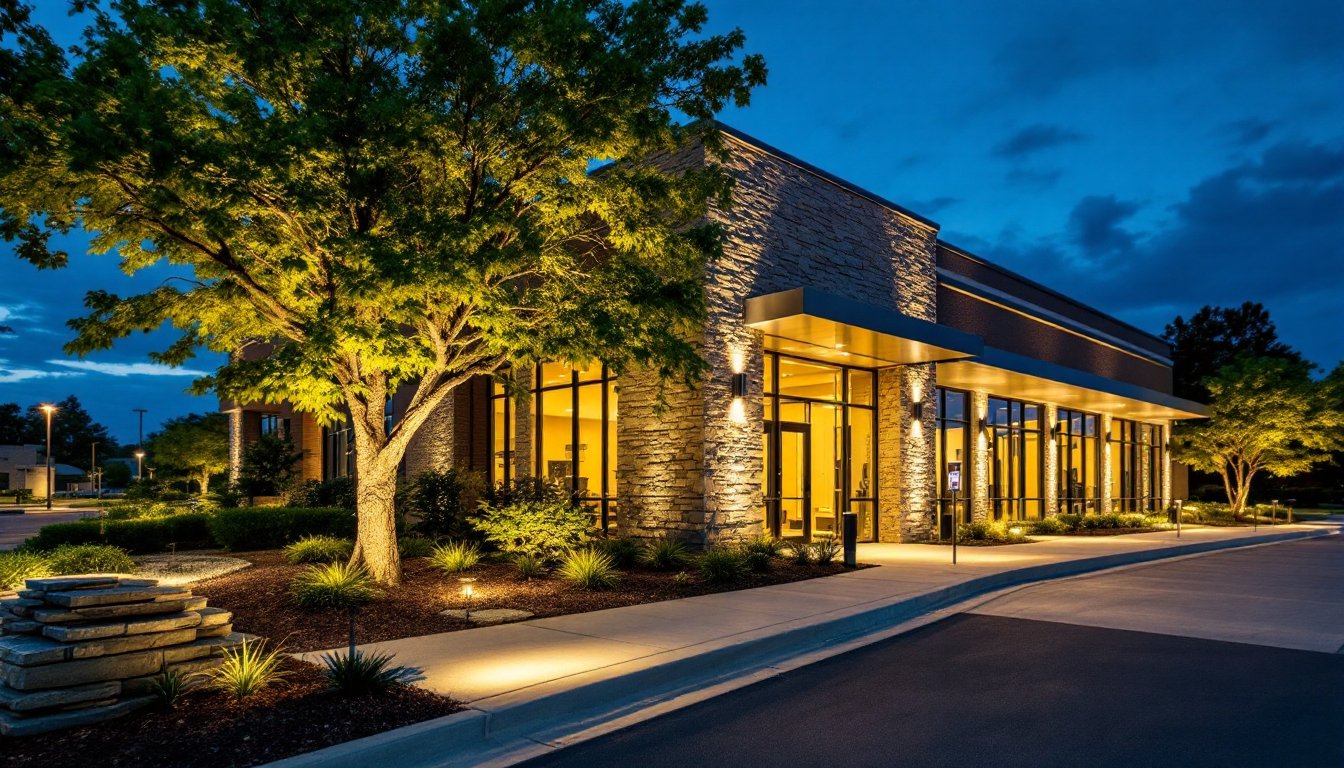
Uplighting places fixtures at ground level, aiming upward to wash building facades, tree canopies, or signage. Use well lights (recessed in-ground) or bullet lights (surface-mounted) with adjustable heads. This technique works exceptionally well for columns, stone walls, and mature trees with interesting bark or branch structure.
Downlighting mounts fixtures overhead, on eaves, pergolas, or tree branches, to mimic natural moonlight. It provides ambient illumination for patios, walkways, and seating areas without the harshness of pole-mounted floods. Pair with shielded fixtures to prevent glare.
Path lighting uses low-level fixtures (typically 12–24 inches tall) to define walkways and borders. Spacing varies by fixture output, but 10–15 feet on center is common for commercial paths. Choose fixtures with integrated shields or louvered lenses to eliminate upward light spill that contributes to light pollution.
Grazing positions fixtures close to textured surfaces, brick, stone, stucco, to emphasize relief and shadow. It’s effective on feature walls, fountains, or sculptural elements. Keep fixtures within 6–12 inches of the surface for maximum effect.
Silhouetting places a light source behind an object (statue, ornamental grass, architectural screen) to create a dark outline against an illuminated background. This technique requires a bright backdrop, a light-colored wall or fence.
Each technique serves a purpose. Overlapping two or three within a single project creates visual rhythm without chaos.
Choosing the Right Fixtures and Technology
Commercial-grade fixtures differ significantly from residential products. Durability, lumen output, and serviceability matter more than decorative housing.
LED vs. other technologies: LEDs dominate commercial installations for good reason, efficacy (lumens per watt), lifespan, and dimming capability outpace halogen and HID options. Look for fixtures rated for 50,000+ hours with replaceable drivers and optics. Integrated LED fixtures (where the LED is permanent) can be harder to service in the field.
Material and IP rating: Commercial landscapes see more abuse than residential yards. Choose fixtures with die-cast aluminum or marine-grade brass housings. IP65 or higher (dust-tight, protected against water jets) is standard for ground-mounted and exposed installations. Coastal properties need additional corrosion resistance.
Voltage systems: Low-voltage (12V or 24V) systems dominate landscape lighting for safety and flexibility, but commercial projects often require line-voltage (120V) for high-output area floods, parking lot poles, or long cable runs where voltage drop becomes an issue. Consult a licensed electrician, line-voltage work often requires permits and must meet National Electrical Code (NEC) standards.
Smart controls and dimming: Timers, photocells, and networked control systems (like DALI or DMX) allow scheduling, zone dimming, and remote management. These systems pay for themselves in energy savings and reduce light pollution during off-hours. Dimming also extends LED life.
Avoid bargain-bin fixtures for commercial work. A $40 fixture that fails in 18 months costs more in labor and downtime than a $120 fixture that runs for a decade.
Planning Your Commercial Landscape Lighting Project
Successful commercial lighting projects start with a site survey and photometric plan, not a shopping cart full of fixtures.
Conduct a nighttime site walk. Identify existing light sources (streetlights, neighboring properties, building-mounted floods) and dark zones. Note security concerns, code-required minimums for egress paths, and features worth highlighting.
Develop a lighting plan. Sketch fixture locations, note wattages, and calculate coverage. Professional designers use photometric software (AGi32, Visual, or DIALux) to model light levels and ensure code compliance. For complex projects, parking lots, multi-building campuses, hire a lighting designer or electrical engineer. Their plans satisfy permitting authorities and prevent costly rework.
Budget realistically. Commercial landscape lighting costs vary widely based on project scope, fixture quality, and labor. Small installations (a single building façade or courtyard) might run $3,000–$8,000, while large multi-acre properties can exceed $50,000. Factor in trenching, conduit, transformer or control panel installation, and permits. Electrical work must be performed by licensed contractors in most jurisdictions.
Permitting and inspection: Line-voltage outdoor lighting typically requires an electrical permit. Even low-voltage systems may need review if they’re part of new construction or significant remodels. Budget 2–4 weeks for permit approval in most areas.
Maintenance access: Design with serviceability in mind. Use junction boxes for splices, label circuits, and choose fixtures with tool-free lamp or driver access. Create a maintenance log noting fixture locations, installation dates, and replacement schedules.
Test before final installation. Mock up key lighting scenes with temporary fixtures to confirm beam angles, color temperature, and intensity. Adjusting fixture placement in dirt is easier than after concrete pours or sod installation.
A well-planned commercial landscape lighting system delivers years of reliable service, enhances property value, and transforms after-dark curb appeal into a competitive advantage.