
Industrial facilities, warehouses, and commercial yards operate around the clock, and proper outdoor lighting isn’t optional. Poor illumination increases accident risk, invites theft, and creates liability headaches. Yet many operators settle for outdated fixtures that drain energy budgets and require constant bulb swaps. Modern outdoor industrial lighting has evolved beyond basic security lamps into systems that slash operating costs, improve visibility, and meet stringent code requirements. This guide breaks down fixture types, essential features, and upgrade benefits so facility managers can make informed decisions that balance performance with long-term value.
Table of Contents
ToggleKey Takeaways
- Outdoor industrial lighting systems must meet OSHA and IBC code requirements, with inadequate illumination exposing facilities to fines, liability, and increased accident risk.
- LED fixtures cut energy consumption by 50-75% compared to HID equivalents, reducing a typical facility’s annual lighting bill from $24,000+ to under $8,000 and achieving ROI in 18-36 months.
- Essential selection criteria for outdoor industrial lighting include IP65+ ingress protection ratings, IK08 impact resistance, operating temperature ranges of -40°F to 122°F, and 5+ year warranties.
- Well-lit perimeters act as crime deterrents and enable security cameras to capture usable footage, while integrated motion sensors and adaptive dimming reduce energy use by 30-50% during low-activity periods.
- Modern LED fixtures eliminate frequent maintenance cycles (HID lamps require replacement every 10,000-20,000 hours), saving $3,000-6,000 annually in labor and parts costs.
- Upgrading to compliant outdoor industrial lighting demonstrates due diligence for insurance and regulatory audits, with some insurers offering premium reductions for facilities using modern, well-maintained systems.
What Is Outdoor Industrial Lighting and Why Does It Matter?
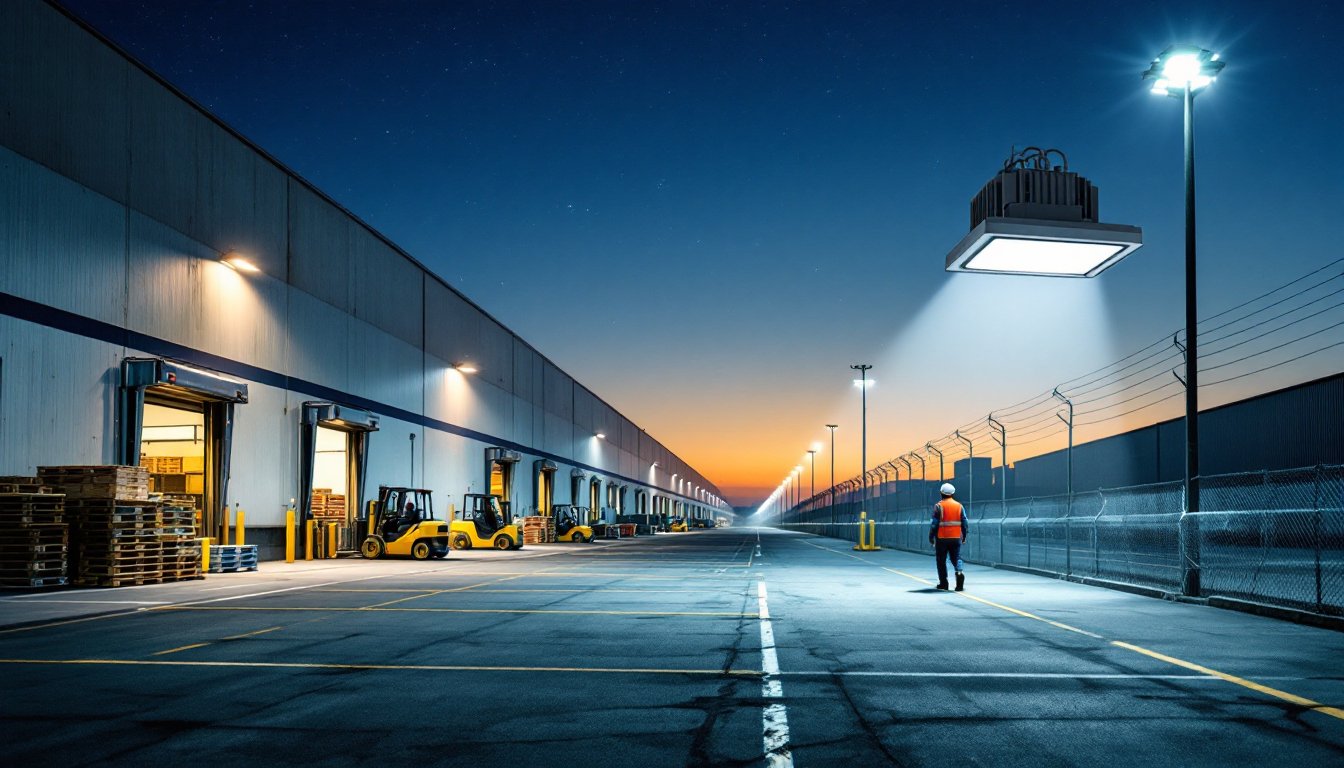
Outdoor industrial lighting refers to heavy-duty fixtures designed for commercial and industrial exteriors, parking lots, loading docks, perimeter fences, equipment yards, and building facades. Unlike residential landscape lighting, these systems deliver high lumen output (often 10,000+ lumens per fixture), withstand harsh weather, and run 10-14 hours daily or continuously.
The stakes go beyond visibility. OSHA regulations require adequate illumination in work areas, with minimum foot-candle levels varying by task type. The International Building Code (IBC) sets baseline standards for egress lighting and general safety. Local jurisdictions often layer on dark-sky ordinances to limit light pollution and glare. Ignoring these requirements exposes operators to fines and increased liability if an injury occurs in a poorly lit area.
Proper lighting also acts as crime deterrent. Studies consistently show well-lit perimeters reduce trespassing and vandalism. For facilities handling high-value inventory or hazardous materials, lighting integrates with surveillance systems to provide usable footage, cameras can’t capture detail in shadows. Energy costs matter too. A facility running 50 legacy high-pressure sodium fixtures at 400W each burns roughly 240,000 kWh annually at typical industrial rates, that’s $24,000+ per year in many markets. Modern LED equivalents cut that figure by 60-70% while delivering better color rendering and lifespan.
Key Types of Outdoor Industrial Lighting Fixtures
LED Floodlights and High Bay Lights
LED floodlights dominate large-area applications, equipment yards, shipping docks, and perimeter zones. They mount on poles, building walls, or truss structures and deliver wide beam spreads (90-120 degrees typical). Look for fixtures rated 150W to 600W LED (replacing 400W to 1000W HID lamps) with efficacy above 130 lumens per watt. Quality units use separate LED drivers that can be replaced without discarding the entire fixture.
High bay lights suit covered loading areas and canopies where ceiling height exceeds 15 feet. These use narrower beam angles (60-90 degrees) to concentrate light downward. Many operators prefer UFO-style high bays with integrated heatsinks over linear designs for outdoor canopies, they shed rain and snow better. Verify the housing is rated IP65 or higher (dust-tight, protected against water jets) and includes impact-resistant polycarbonate lenses rated IK08 or above.
Both fixture types benefit from photocell or astronomical timer controls to automate dusk-to-dawn operation. Advanced systems integrate 0-10V dimming or DALI protocols for adaptive lighting that reduces output during low-activity hours.
Wall Packs and Area Lighting
Wall packs mount directly to building exteriors and provide semi-cutoff or full-cutoff distribution patterns. Full-cutoff designs (light directed downward, minimal upward spill) comply with dark-sky ordinances and reduce glare for neighboring properties. Standard sizes range from 30W to 100W LED, replacing 70W to 250W metal halide equivalents.
Modern wall packs ship with integrated dusk-to-dawn photocells and optional motion sensors that boost output when activity is detected. This hybrid approach cuts energy use by 30-50% in low-traffic zones while maintaining safety baselines.
Area lights (also called parking lot fixtures) mount on poles 15-40 feet tall with Type III, IV, or V distribution patterns, these IES classifications define light spread. Type III suits rectangular lots and roadways, directing light forward. Type V provides circular, 360-degree coverage for center-of-lot poles. Facilities with existing pole infrastructure can retrofit shoebox-style area lights with slip-fitter mounts for quick upgrades without re-wiring.
Always match pole height to fixture wattage and distribution. A 200W Type III fixture on a 25-foot pole delivers roughly 1.5-2.0 foot-candles average across a 60×40-foot zone, adequate for general parking but insufficient for loading docks requiring 5+ foot-candles.
Essential Features to Consider When Selecting Industrial Outdoor Lights
IP and IK ratings top the list. IP (Ingress Protection) ratings use a two-digit format: first digit for solids (dust), second for liquids. IP65 (dust-tight, water-jet resistant) is baseline: coastal or high-pressure washdown areas need IP66 or IP67. IK (Impact Protection) ratings measure mechanical resistance, IK08 withstands 5 joules (roughly a 3-pound wrench dropped from 16 inches). Loading docks and equipment yards should target IK08 minimum: perimeter fixtures can use IK07.
Operating temperature range matters in extreme climates. Quality LED fixtures function from -40°F to 122°F without performance loss. Cheaper units derate output above 85°F or fail to start in subzero cold. Check the datasheet for lumen maintenance curves showing L70 lifespan (hours until output drops to 70% of initial). Industrial-grade LEDs reach 80,000-100,000 hours L70 with proper thermal management.
Color temperature and CRI affect task visibility and security. 4000K-5000K (neutral to cool white) improves color differentiation for detailed work and enhances camera footage quality. CRI (Color Rendering Index) above 70 is standard: precision tasks or paint/coating inspection justify CRI 80+.
Surge protection (minimum 10kV, preferably 20kV) guards against lightning and grid transients common in industrial areas. Fixtures lacking integrated protection need separate suppression at the circuit level.
Mounting options include slip-fitter (adjustable pole-top), yoke (adjustable angle for walls or ground), and trunnion (heavy-duty for extreme angles). Confirm adjustability range, some yokes offer ±90 degrees, others limit to ±45 degrees. For pole retrofits, verify slip-fitter diameter (typically 2-3/8 inches, but not universal).
Warranty length signals manufacturer confidence. Industrial fixtures should carry 5-year minimum warranties covering driver, LEDs, and housing. Ten-year warranties are increasingly common on premium lines. Read the fine print, some exclude coastal installations or require professional installation for validity.
Top Benefits of Upgrading Your Outdoor Industrial Lighting
Energy savings deliver the most immediate ROI. LED fixtures use 50-75% less energy than HID equivalents. A facility replacing fifty 400W metal halides with 150W LEDs saves roughly 12,500W per fixture-hour. Over 12-hour nightly operation and 365 days, that’s 54,750 kWh annually, worth $5,475 to $8,212 depending on regional utility rates. Many power companies offer commercial lighting rebates covering 20-50% of upgrade costs, shortening payback to 18-36 months.
Maintenance reduction cuts labor and equipment expenses. HID lamps need replacement every 10,000-20,000 hours: LED fixtures run 5-7 years before any service. Facilities pay bucket trucks and electricians $150-300 per fixture change. Eliminating 20 annual lamp swaps saves $3,000-6,000 in labor alone, not counting bulb costs.
Improved visibility reduces accidents and liability exposure. LEDs deliver instant-on full brightness (no warm-up period) and maintain consistent color temperature over their lifespan. HID lamps shift toward orange/pink as they age, distorting color perception. Better light quality improves worker alertness and reduces eye strain during long shifts.
Enhanced security comes from improved camera performance and consistent illumination. LED fixtures don’t cycle on and off like failing HID lamps, eliminating dark patches. Many modern systems integrate with building management platforms, allowing remote monitoring, scheduling, and troubleshooting. Motion-sensing and adaptive dimming add layers of efficiency without compromising safety.
Compliance and liability protection matter for insurance and regulatory audits. Upgrading to code-compliant, properly aimed fixtures with photometric reports demonstrates due diligence. Some insurers offer premium reductions for facilities with modern, well-maintained lighting systems, savings that compound over years.
Conclusion
Outdoor industrial lighting isn’t a set-it-and-forget-it expense, it’s infrastructure that affects safety, security, and operating costs every single night. Operators who evaluate fixture types, prioritize IP/IK ratings, and calculate total cost of ownership (not just upfront price) position their facilities for years of reliable performance. LED technology has matured to the point where upgrades pencil out in under three years for most applications. The real question isn’t whether to upgrade, but how soon the facility can capture those savings and operational improvements.