
Landscape lighting transforms outdoor spaces after dark, but the difference between a system that lasts a decade and one that fails in a year often comes down to one overlooked component: wire connectors. These small devices protect electrical connections from moisture, corrosion, and physical damage, the three biggest enemies of low-voltage outdoor wiring. Unlike interior electrical work, landscape lighting operates in an environment where water infiltration is constant, temperature swings are extreme, and direct burial cables face compression and abrasion. Choosing and installing the right connectors isn’t optional: it’s the foundation of a reliable system that won’t require digging up pathways or troubleshooting dead fixtures every season.
Table of Contents
ToggleKey Takeaways
- Landscape lighting wire connectors are essential to system longevity, protecting outdoor connections from moisture, corrosion, and physical damage that cause fixture failures.
- Silicone-filled direct-burial-rated connectors are the gold standard for landscape lighting, while heat-shrink and push-in gel options excel in specific installation scenarios.
- Proper wire preparation—including correct strip length and secure mechanical twisting—is critical; a well-installed $2 connector outperforms a poorly-installed $5 connector.
- Always verify UL listing for wet locations and direct burial, choose connectors rated for your wire gauge and current load, and test voltage before burying connections.
- Make connections above grade when possible, bury splices at least 6 inches deep, and orient connections downward to prevent water pooling and premature failure.
What Are Landscape Lighting Wire Connectors?
Landscape lighting wire connectors are specialized electrical components designed to join low-voltage wires (typically 12V or 24V systems) in outdoor environments. Unlike standard wire nuts used indoors, these connectors incorporate weatherproofing features to prevent moisture intrusion, which causes voltage drop, corrosion, and complete circuit failure.
Most landscape lighting systems use stranded copper wire in gauges from 10 AWG to 16 AWG, depending on run length and fixture load. Connectors must accommodate these wire sizes while maintaining a secure mechanical connection and complete electrical contact. The best designs also include features like dielectric grease or silicone gel that displaces water and seals out humidity.
These connectors differ from automotive or marine connectors in their voltage rating and installation method. Landscape connectors are optimized for direct burial applications and must meet UL listing standards for wet locations. They typically handle currents from 5 to 15 amps, sufficient for most residential low-voltage lighting loads.
The connector body itself may be made from UV-resistant plastics, rubber compounds, or thermoplastic elastomers that remain flexible in temperature extremes. Internal components, usually brass or copper alloy, provide the actual electrical pathway. Quality connectors use spring-loaded or compression mechanisms that maintain pressure on the wire interface over time, compensating for thermal expansion and contraction cycles that would loosen inferior designs.
Types of Wire Connectors for Outdoor Lighting Systems
Waterproof Wire Connectors and Silicone-Filled Options
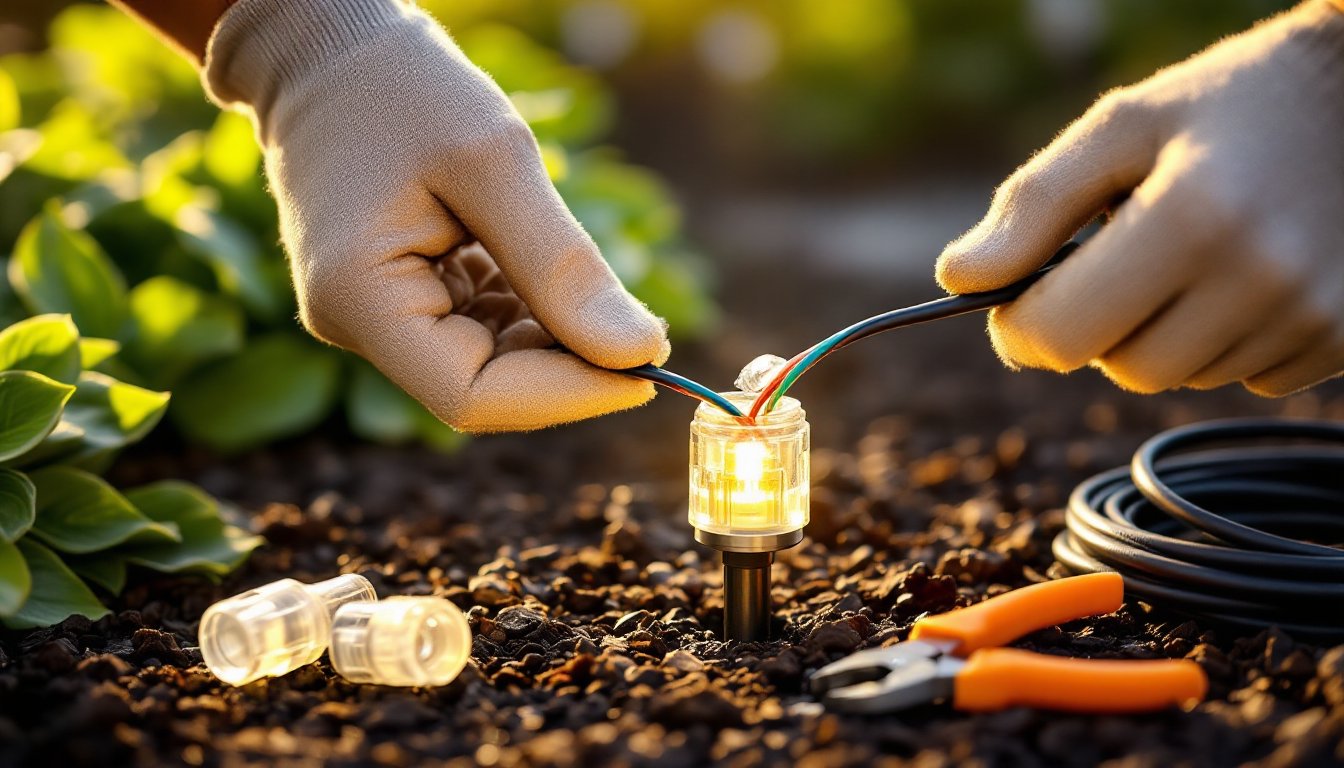
Silicone-filled wire connectors (often called “DBR” or direct-burial-rated connectors) are the gold standard for landscape lighting. These feature a cap pre-filled with silicone dielectric gel that encapsulates the wire connection when twisted onto stripped wire ends. The silicone displaces any moisture and creates a permanent waterproof seal.
Installation requires twisting wires together, then threading the silicone-filled cap over the connection and twisting until the gel oozes out, confirming full encapsulation. These connectors handle wire sizes from 18 AWG to 10 AWG and work well in valve boxes, direct burial, or exposed junction points. They’re rated for continuous submersion and resist UV degradation.
Heat-shrink connectors with adhesive liners offer an alternative. These consist of a pre-insulated butt splice covered by heat-shrink tubing with a hot-melt adhesive inner layer. When heated with a heat gun (not a lighter, uneven heating causes failure), the tubing contracts and the adhesive melts, creating a waterproof seal. They provide a lower-profile connection than silicone caps, useful in tight spaces or when aesthetics matter.
Traditional grease-filled wire nuts are still used but represent older technology. They require manual application of dielectric grease and multiple wraps of self-fusing silicone tape or electrical tape for weatherproofing, more labor-intensive and less reliable than modern alternatives.
Quick-Connect and Push-In Connectors
T-tap connectors (or vampire taps) allow mid-run connections without cutting the main wire. A metal blade pierces the insulation of the main cable when the connector is crimped shut, while a secondary port accepts the branch wire. They’re fast but controversial, improper installation can nick conductors, creating resistance and heat. Use only UL-listed versions with insulation-displacing blades designed for landscape wire gauge.
Push-in gel-filled connectors represent the newest technology. These use a spring-loaded clamp mechanism inside a gel-filled chamber. Stripped wire ends insert into ports, where internal springs grip the conductor while gel seals the connection. No twisting or tools required. They’re faster than silicone caps but costlier per unit. Look for models rated for direct burial and compatible with both solid and stranded wire.
Lever-style connectors (similar to those used in residential electrical boxes) are appearing in landscape-grade versions with sealed housings. These allow tool-free connection and disconnection, helpful for seasonal systems or when troubleshooting. But, they require protected locations (inside transformer enclosures or junction boxes) rather than direct burial, as the lever mechanism can’t be fully encapsulated in gel.
How to Choose the Right Connectors for Your Installation
The first decision point is wire gauge compatibility. Connector packaging lists acceptable wire sizes, using connectors rated for 14-18 AWG on a 10 AWG main line results in poor contact and voltage drop. When connecting different gauge wires (common when tapping a 12 AWG main line with 14 AWG fixture leads), choose connectors rated for the range, or use reducing adapters.
Installation environment dictates waterproofing level. Connections inside a transformer or weatherproof junction box need splash protection but not submersion rating. Direct-buried splices or connections in valve boxes that may flood require full submersion rating and gel or silicone encapsulation. If the area has high water tables or seasonal flooding, add extra protection by placing connections inside waterproof junction boxes before burial.
Consider connection permanence. Silicone-filled and heat-shrink connectors create permanent joints, they can’t be disconnected without destroying the connector. If the system may need future modification, use reusable gel-filled push-in connectors or lever-style connectors in protected boxes.
Wire count per connection matters. Joining two wires is straightforward, but multi-wire junctions (branching one main line into three fixture runs) require connectors rated for the total conductor count. Some silicone caps accommodate up to six wires: others max out at three. Push-in connectors typically offer 2-port or 3-port configurations.
Check for UL listing specific to wet locations and direct burial. A general-purpose electrical connector might have a UL listing but not for the conditions landscape lighting faces. The packaging should explicitly state “direct burial rated” or “suitable for wet locations” with the corresponding UL standard.
Finally, match current capacity to system load. While most low-voltage connectors handle 10-15 amps (far exceeding typical landscape lighting loads of 2-5 amps per run), undersized connectors on high-load circuits create heat and resistance. Calculate total wattage on the run, divide by system voltage, and ensure connector amperage rating exceeds the result by at least 25%.
Step-by-Step Installation and Best Practices
Safety first: Even though landscape lighting is low-voltage (12V or 24V), always disconnect power at the transformer before making connections. Low-voltage won’t shock, but short circuits can damage transformers and create fire hazards.
Wire preparation determines connection quality. Use wire strippers (not utility knives or teeth) to remove insulation. Strip lengths vary by connector type, silicone caps typically need 5/8-inch of exposed conductor, while push-in connectors specify exact strip lengths (often 1/2-inch). Too little exposed wire creates poor contact: too much leaves bare copper vulnerable to corrosion.
For silicone-filled connectors:
- Strip all wires to be joined to the specified length
- Twist wire ends together clockwise using lineman’s pliers for a tight mechanical bond
- Thread the silicone cap over the twisted connection
- Twist the cap clockwise until firm resistance is felt and silicone gel extrudes from vent holes
- Wipe excess gel from the connector body
- Orient the connection downward or horizontally (never facing up) to prevent water pooling at the entry point
For heat-shrink connectors:
- Strip wires according to connector instructions (usually 1/4-inch)
- Insert wire ends into opposite ends of the butt splice until they meet in the middle
- Crimp the metal sleeve firmly with a ratcheting crimper (not pliers, improper crimps are the leading cause of failure)
- Apply heat with a heat gun using even, sweeping motion until the tubing fully contracts and adhesive oozes from both ends
- Allow to cool completely before moving
For push-in gel connectors:
- Strip wires to the exact length marked on the connector body (usually 1/2-inch)
- Insert each stripped wire into a port until it bottoms out, a distinct click confirms engagement
- Tug gently on each wire to verify the spring clamp has gripped
- Ensure gel surrounds all entry points
General best practices apply to all connector types:
- Make connections above grade when possible, then bury slack wire in a loop. This allows future access without excavation.
- Place buried connections at least 6 inches deep, following NEC guidelines for low-voltage landscape lighting (though local codes may vary).
- Use landscape marking flags or take photos with measurements to record splice locations before backfilling.
- Apply a small amount of dielectric grease to wire ends before connecting (even with gel-filled connectors) for added corrosion protection.
- Avoid tension on connections, leave a small service loop so wire movement doesn’t stress the splice.
- Test the circuit immediately after making connections and before burial. Use a multimeter to verify voltage at the connection point matches transformer output (accounting for normal voltage drop).
- In areas with burrowing animals, consider running wire through conduit (schedule 40 PVC) to protect splices from gnawing damage.
Common mistakes to avoid: over-tightening twist-on connectors (which can crack housings), under-crimping heat-shrink connectors (loose crimps create resistance), mixing wire types (copper and aluminum require special anti-oxidant connectors), and making connections in standing water (always pump out valve boxes first).
Conclusion
The connector might be the smallest component in a landscape lighting system, but it’s the one that determines whether the system works next year. Silicone-filled connectors remain the most reliable choice for direct burial applications, while heat-shrink and push-in options excel in specific scenarios. Proper wire preparation, installation technique, and environmental considerations matter more than connector brand. A $2 connector installed correctly outlasts a $5 connector twisted on poorly. Focus on the fundamentals, strip length, mechanical bond, complete gel encapsulation, and protection from physical damage, and the lights will still be working when it’s time to replace the fixtures themselves.