
Fumbling through a dark closet every morning isn’t just annoying, it’s inefficient. Proper lighting transforms a cluttered cave into a functional space where every shirt, shoe, and accessory is visible at a glance. Whether someone’s working with a walk-in closet or a cramped reach-in, the right lighting setup makes mornings smoother and keeps favorite items from getting lost in the shadows. This guide breaks down the most practical closet lighting solutions available in 2026, from budget-friendly battery-powered options to integrated smart systems, with real-world installation advice that skips the fluff.
Table of Contents
ToggleKey Takeaways
- Proper closet lighting solutions improve visibility for color-matching, enhance safety, and can increase home resale value by making spaces feel twice as expensive during showings.
- LED strip lights at 4000K neutral white offer the best all-around closet lighting, consuming just 4-8 watts per foot and providing 300-600 lumens for true task lighting when hardwired.
- Motion-activated lights eliminate fumbling for switches—battery-powered puck lights work best for rentals or reach-in closets, while hardwired motion sensors are ideal for permanent installations in larger spaces.
- Battery-powered closet lighting requires minimal installation and works rental-friendly at $15-40 per fixture, but demands frequent battery changes and provides limited brightness compared to hardwired options.
- Surface preparation is critical for adhesive-backed strips: clean with isopropyl alcohol, lightly sand painted surfaces, and test placement with painter’s tape before permanent installation.
- Smart closet lighting systems offer automation and dimming but add complexity; a simple motion sensor often delivers practical benefits without Wi-Fi maintenance headaches for typical closet use.
Why Proper Closet Lighting Matters
Good closet lighting isn’t about aesthetics, it’s about function. A properly lit closet allows accurate color matching, which prevents the dreaded “Did I really wear navy and black together?” moment at the office. Poor lighting also hides dust, forgotten items, and organizational problems that fester until the closet becomes unusable.
From a practical standpoint, most closets get zero natural light and rely entirely on ambient spill from a bedroom fixture. That’s rarely enough. The International Residential Code (IRC) doesn’t mandate closet lighting, but it does restrict certain fixture types near combustible materials, something to keep in mind during installation.
Adequate lighting also improves safety. Shadowy corners hide tripping hazards, unstable stacks, and sharp edges. For anyone storing tools, sporting equipment, or seasonal gear in closets, visibility reduces the risk of minor injuries during retrieval.
Finally, lighting affects resale value. Homebuyers notice details like well-lit closets, especially in primary bedrooms and walk-ins. A $50 lighting upgrade can make a space feel twice as expensive during showings.
LED Strip Lights: Versatile and Energy-Efficient
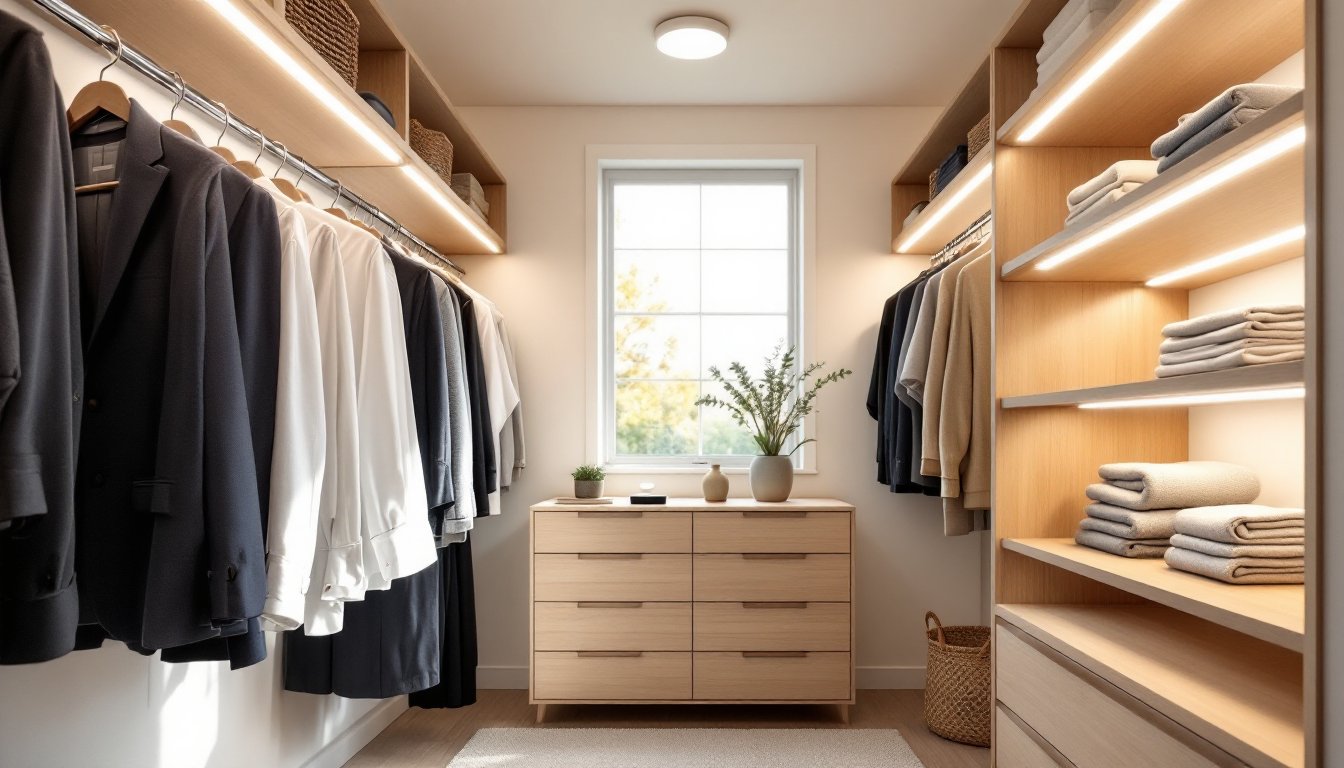
LED strip lights have become the go-to solution for DIY closet lighting, and for good reason. They’re flexible, low-profile, and consume minimal power, typically 4-8 watts per foot, making them ideal for spaces that don’t have dedicated circuits.
Strips come in adhesive-backed rolls, usually sold in 16.4-foot (5-meter) spools. They’re cuttable at designated intervals (marked with scissor icons), so a homeowner can trim them to exact shelf lengths without waste. Most strips operate on 12V or 24V DC, requiring a plug-in transformer or hardwired driver.
Choosing the Right Color Temperature
Color temperature matters more than most people think. Measured in Kelvin (K), it dictates how colors appear:
- 2700-3000K (warm white): Creates a cozy feel but can distort cooler clothing tones.
- 4000-4500K (neutral white): Best all-around choice for closets: shows true colors without feeling clinical.
- 5000-6500K (daylight): Excellent for color-matching, but can feel harsh in small spaces.
For closets, 4000K neutral white hits the sweet spot, it’s bright enough for detail work but doesn’t feel like an interrogation room.
Installation Considerations
LED strips adhere to clean, smooth surfaces, wood, metal, or painted drywall. Rough or textured surfaces need aluminum channels (also called profiles) for secure mounting. These channels also diffuse the individual LED dots, creating a cleaner light line.
Power supply placement matters. The transformer needs ventilation and shouldn’t be buried behind insulation or sealed in a junction box unless it’s rated for enclosed spaces. Most plug-in drivers are fine hanging loose, but hardwired versions require proper electrical boxes per National Electrical Code (NEC) Article 314.
Motion-Activated Closet Lights for Hands-Free Convenience
Motion sensors eliminate the need to fumble for switches when someone’s carrying laundry or grabbing a jacket on the way out. PIR (passive infrared) sensors detect body heat and trigger lights automatically, with adjustable timeout settings, usually 15 seconds to 5 minutes.
Most motion-activated closet lights fall into two categories: standalone battery-powered puck lights and hardwired systems integrated into existing LED strips or fixtures.
Battery-Powered Motion Pucks
These adhesive-mounted puck lights run on AA or AAA batteries and work well in closets without electrical access. Better models use 3 AAA batteries and last 6-12 months with typical use. They mount on ceilings, walls, or under shelves.
The catch? Detection range is limited, usually 6-10 feet, so they work best in reach-in closets or on specific shelves in walk-ins. Also, battery replacements become tedious in multi-light setups.
Hardwired Motion Sensors
For permanent installations, hardwired motion-sensing switches replace standard light switches and control any fixture on that circuit. These require basic electrical skills: turning off the breaker, identifying line and load wires, and connecting the sensor per manufacturer wiring diagrams.
Some LED strip controllers include built-in motion sensors, combining both functions in one unit. These are usually hardwired to a junction box and control low-voltage strips directly.
Safety note: Always verify power is off with a non-contact voltage tester before touching any wires. If a closet shares a circuit with other rooms, identify the correct breaker first to avoid killing power elsewhere.
Battery-Powered vs. Hardwired Options
The choice between battery-powered and hardwired lighting boils down to three factors: existing electrical access, permanence, and maintenance tolerance.
Battery-Powered Advantages
Installation speed: Peel, stick, done. No permits, no electrical knowledge required.
Rental-friendly: Renters can take them when they move.
Cost: Quality battery puck lights range from $15-40 per fixture, with no electrician fees.
Battery-Powered Drawbacks
Maintenance: Changing batteries in six ceiling-mounted pucks every few months gets old fast.
Brightness limits: Battery fixtures max out around 60-100 lumens per puck, fine for accent lighting, inadequate as primary illumination in larger closets.
Inconsistent performance: As batteries drain, light output dims noticeably before dying.
Hardwired Advantages
Set and forget: Once installed, hardwired systems need zero maintenance beyond occasional bulb replacement (if not using LEDs).
Superior brightness: Hardwired LED strips and fixtures deliver 300-600 lumens per foot, providing true task lighting.
Integration: Hardwired setups can connect to smart home systems, timers, or existing three-way switches.
Hardwired Drawbacks
Installation complexity: Running new wire through finished walls requires cutting drywall, drilling studs, and patching. If there’s no attic or crawl space access above the closet, fishing wire becomes difficult.
Permits: Many jurisdictions require electrical permits for new circuits or junction box installations. Check local codes before starting.
Cost: A licensed electrician charges $75-150 per hour (2026 rates), and a full closet lighting installation can take 2-4 hours depending on access.
The Hybrid Approach
Some homeowners start with battery-powered lights to test layouts, then upgrade to hardwired once they’ve identified optimal placement. Another option: hardwire the main lighting and use battery pucks as supplemental accent lights in corners or drawers.
Smart Lighting Systems for Modern Closets
Smart lighting brings automation and customization to closets, though it’s worth asking whether voice control is really necessary for a space someone visits for 90 seconds at a time.
That said, smart systems offer practical benefits: scheduled lighting (lights turn on at 6:30 AM weekdays), dimming capability, and color-changing options for mood or task-specific lighting. Systems integrate with Alexa, Google Home, or Apple HomeKit, allowing voice or app control.
Smart LED Strip Controllers
Wi-Fi or Zigbee-enabled controllers replace standard LED strip power supplies. They connect to home networks and accept commands from phones or smart hubs. Most support dimming and, if using RGB strips, full color control.
Installation mirrors standard LED strip setup, but the controller needs Wi-Fi signal. Closets with thick walls or distance from routers may need a mesh Wi-Fi extender or a Zigbee hub for reliable connectivity.
Smart Switches and Dimmers
For those with existing hardwired closet lights, smart switches replace conventional switches. Brands like Lutron, Leviton, and GE offer models with neutral wire requirements (most modern homes have them) and no-neutral versions for older wiring.
These require slightly more complex wiring than dumb switches, typically line, load, neutral, and ground connections, but detailed instructions usually accompany the product. A wire stripper, voltage tester, and screwdriver are the only tools needed.
Motion + Smart Combo
Some smart systems combine motion sensing with automation, allowing rules like “Turn on at 50% brightness if motion is detected between 11 PM and 6 AM.” This prevents blinding oneself during midnight clothing emergencies while maintaining full brightness during the day.
The downside? Complexity. Smart systems need ongoing network maintenance, firmware updates, and troubleshooting when Wi-Fi acts up. For many closets, a simple motion sensor does the job without the smart home ecosystem headache.
Installation Tips for Your Closet Lighting
Proper installation separates a clean, professional-looking closet lighting system from a tangled mess of wires and crooked strips.
Surface Preparation
Adhesive-backed LED strips and battery pucks stick only as well as the surface allows. Clean mounting areas with isopropyl alcohol (70% or higher) and let dry completely. Dust, oils from hands, or existing paint sheen reduce adhesion dramatically.
For painted wood shelves or walls, lightly scuff the surface with 220-grit sandpaper, wipe clean, then apply the light. This creates better mechanical grip without damaging finishes.
Measure Twice, Stick Once
LED strips are repositionable for about 10 seconds after application, after that, the adhesive bonds firmly and pulling them off damages both strip and surface. Use painter’s tape to mark mounting lines and verify placement before removing backing.
For shelf lighting, position strips 1-2 inches from the front edge to minimize glare while maximizing light spread. Mounting too far back casts shadows: too far forward creates blinding hotspots.
Wire Management
Loose wires look sloppy and create snag hazards. Use adhesive cable clips to route low-voltage wiring along corners or behind molding. For hardwired installations, wires run through walls to junction boxes, never leave Romex exposed on surfaces.
If running wire through walls, avoid exterior walls with insulation unless using insulation-rated wire (typically unnecessary for low-voltage DC). Drill holes through studs at least 1.25 inches from the edge and install nail plates to protect wiring from future screw penetrations.
Junction Box Placement
Any hardwired connection, transformer, switch, or fixture, needs an accessible junction box. NEC prohibits burying boxes behind drywall or in inaccessible locations. If mounting a transformer in a closet ceiling, ensure the box has adequate volume for wire connections per NEC Article 314.16 (typically a 4-inch square box with 2.125-inch depth).
Safety Gear
Wear safety glasses when drilling overhead, wood shavings and drywall dust fall directly into eyes. Use work gloves when cutting metal channels or handling sharp LED strip ends. If working with existing electrical wiring, turn off the circuit and verify it’s dead with a voltage tester before proceeding.
Testing Before Final Installation
Plug in or power up the system before securing everything permanently. Confirm all strips light up, motion sensors detect properly, and switches control the right fixtures. Troubleshooting after everything’s mounted, patched, and painted is miserable.
Conclusion
Closet lighting doesn’t need to be complicated or expensive to be effective. Battery-powered puck lights solve renters’ problems in under 10 minutes, while hardwired LED strips provide permanent, high-output illumination for serious wardrobe enthusiasts. Motion sensors add convenience without much extra effort, and smart systems offer bells and whistles for those already invested in home automation. The key is matching the solution to the space, skill level, and long-term plans, then actually doing the prep work that makes any installation look professional.