

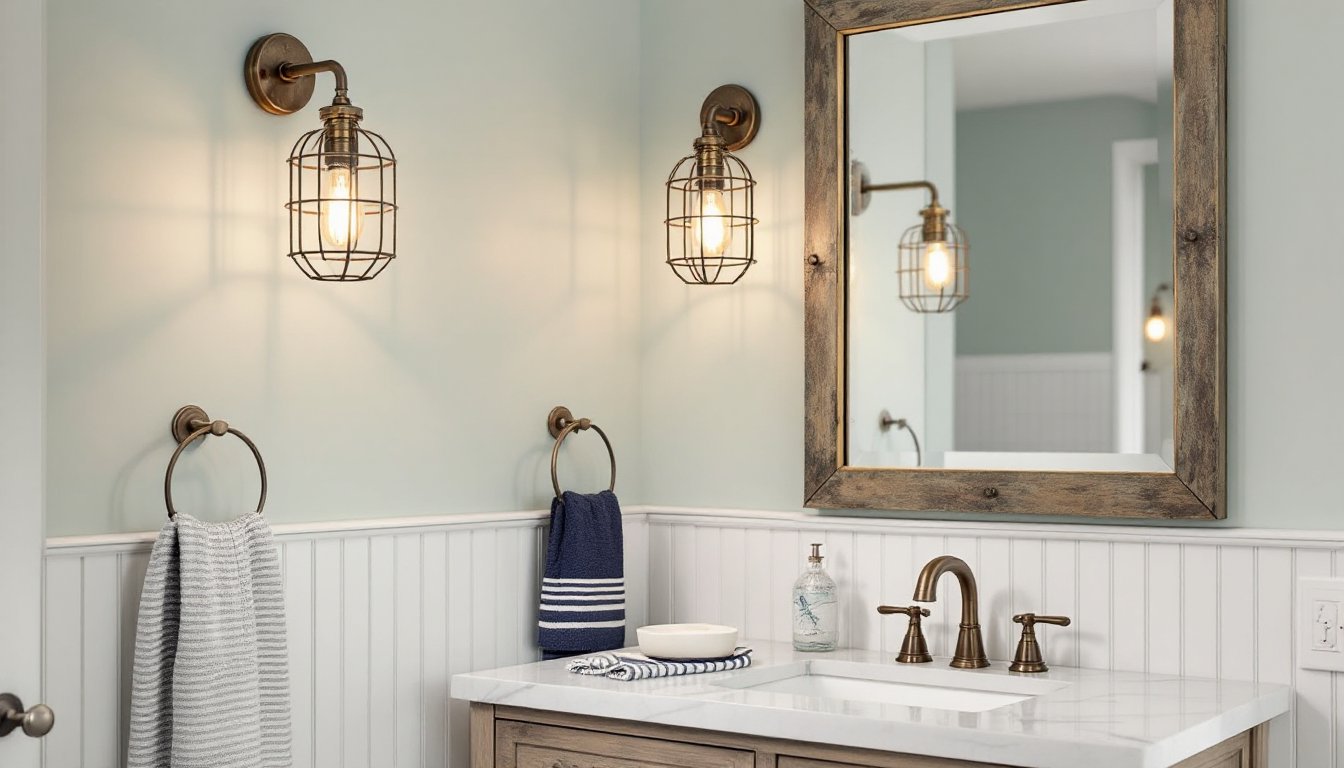
Nautical vanity lighting brings a blend of rugged maritime function and coastal charm to any bathroom. These fixtures originated as working lights on ships and docks, built to withstand salt spray and rough seas, which makes them surprisingly practical for humid, high-moisture bathroom environments. Whether someone’s renovating a beach house or simply craving that weathered coastal vibe inland, nautical-style vanity lights deliver both visual impact and reliable illumination. The right fixture can anchor a full coastal design or serve as a standalone accent in an otherwise modern bath. This guide walks through style options, selection criteria, and installation considerations to help homeowners make smart choices that balance aesthetics with real-world performance.
Table of Contents
ToggleKey Takeaways
- Nautical vanity lighting combines maritime heritage with practical moisture resistance, making it ideal for humid bathrooms where standard fixtures often rust or corrode.
- Cage and bulkhead styles deliver excellent task lighting with exposed bulbs and clear glass, while rope and anchor designs offer decorative flair but require careful placement to avoid looking overly themed.
- Size your nautical vanity light fixture to roughly 60-75% of your mirror width, and aim for 1,600–2,000 lumens for single-sink vanities and 3,000–4,000 lumens for double vanities.
- Install nautical vanity lights at 75–80 inches from the floor to the fixture center to eliminate shadows and ensure even facial illumination for grooming tasks.
- Choose damp or wet-rated fixtures with corrosion-resistant metals like brass, copper, or bronze, and verify your electrical box is properly braced if the fixture exceeds 5 pounds.
- Select warm white bulbs (3000K–3500K) with shatter-resistant coatings, and consider supplemental overhead lighting if architectural shadows persist under the chin or eyes.
What Is Nautical Vanity Lighting?
Nautical vanity lighting refers to bathroom light fixtures designed around maritime themes and industrial hardware commonly found on ships, lighthouses, and dock structures. These fixtures typically feature metal construction, often brass, copper, bronze, or galvanized steel, with protective cages, hooded shades, or bulkhead-style housings.
The design DNA comes from working marine environments where lights needed to resist corrosion, handle moisture, and stay functional through harsh conditions. Many authentic nautical fixtures still use design elements like heavy-duty cast metal bases, porcelain sockets, glass diffusers with protective grills, and visible mounting hardware that doubles as visual detail.
In bathroom applications, nautical vanity lights usually mount above or flanking a mirror, providing task lighting for grooming while reinforcing a coastal or industrial aesthetic. Finishes range from polished chrome and brushed nickel to deliberately weathered patinas that mimic decades of salt exposure.
Quality varies widely. True marine-grade fixtures carry IP (Ingress Protection) ratings indicating sealed construction against moisture and dust. Bathroom installations don’t require full marine certification, but those ratings signal better construction and longer service life in steamy bathroom conditions.
Why Choose Nautical Style for Your Bathroom Vanity?
Nautical fixtures offer more than just coastal aesthetics, they bring practical benefits that align well with bathroom demands.
Moisture resistance tops the list. Fixtures designed for marine use typically feature sealed housings, corrosion-resistant metals, and damp or wet location ratings. Bathrooms generate consistent humidity, and lower-quality vanity lights often show rust, tarnish, or electrical issues within a few years. Nautical-style construction addresses this head-on.
The visual weight of these fixtures works well over substantial vanities and vessel sinks. Heavy metal construction and bold profiles balance larger bathroom features better than delicate sconces or minimalist bars. They read as intentional, not flimsy.
Nautical lighting bridges multiple design styles. It pairs naturally with shiplap, beadboard, reclaimed wood, and subway tile, but also complements industrial, farmhouse, and transitional schemes. The hardware-forward aesthetic doesn’t demand a full nautical theme to make sense in a space.
Finally, these fixtures tend toward exposed-bulb or clear-glass designs that provide excellent color rendering for grooming tasks. Unlike frosted shades that diffuse and soften light, cage and bulkhead fixtures deliver clean, bright illumination that helps with shaving, makeup application, and detail work.
One trade-off: nautical fixtures often lack the adjustable arms or swivel mounts found in some modern vanity lights. Task lighting performance depends on careful placement during installation.
Popular Nautical Vanity Lighting Styles and Designs
Cage and Bulkhead Fixtures
Cage lights feature wire or metal grid guards around exposed bulbs, mimicking work lights used in engine rooms and on deck. The cage protects the bulb from impact while allowing maximum light output. These fixtures work especially well in smaller bathrooms or over single-sink vanities where a compact profile matters.
Bulkhead lights use solid metal housings with a front glass or polycarbonate lens, originally designed to mount flush on ship bulkheads (walls) and withstand direct water exposure. Bathroom versions often feature round or oval bases with visible mounting screws and a slightly domed lens. They throw focused pools of light rather than broad washes, so multiple fixtures or supplemental lighting may be needed over double vanities.
Both styles typically accommodate standard E26 medium-base bulbs. LED Edison-style bulbs work particularly well, delivering warm light with low energy use and the vintage filament look that complements industrial hardware. Dimmable versions allow adjustment between bright task lighting and softer ambient moods.
Cage fixtures generally mount via a standard electrical box and junction box cover plate that becomes part of the visible design. Bulkhead lights often use a gasket or sealed back plate for true weather resistance, overkill for most bathrooms, but a sign of quality construction.
Rope and Anchor-Inspired Lights
These fixtures lean more decorative, incorporating nautical motifs like twisted rope details, anchor-shaped backplates, ship’s wheel elements, or porthole-style frames. They range from subtle nods, a rope-wrapped arm supporting a simple shade, to full thematic designs that announce their coastal intent.
Rope-wrapped fixtures typically use cotton or manila rope either as structural support or applied trim. Quality matters here: cheap synthetic rope looks obviously fake and degrades quickly in humid environments. Natural fiber rope should be sealed or treated for moisture resistance, though it will still darken and age over time. Some homeowners consider this patina desirable: others prefer the consistency of metal-only construction.
Anchor and porthole designs often feature heavier castings and more complex mounting hardware. Verify that the electrical box is properly braced for fixtures exceeding five pounds. Older boxes attached only to drywall won’t support heavy nautical sconces, retrofitting a box brace or installing a new box secured to framing may be necessary.
These decorative styles work best when the bathroom design already incorporates coastal elements. As standalone accent pieces in otherwise neutral bathrooms, they can read as heavy-handed or themey.
How to Choose the Right Nautical Vanity Light for Your Space
Start with fixture sizing relative to the mirror and vanity. A common rule: the light bar or combined width of multiple fixtures should measure roughly 60-75% of the mirror width. A 36-inch mirror pairs well with a 24-inch three-light bar or two 8-inch sconces spaced appropriately.
For single-sink vanities (typically 24 to 36 inches wide), a single cage or bulkhead fixture centered above the mirror often suffices if supplemented with overhead lighting. Double vanities (60 inches and wider) usually benefit from either a long multi-light bar or paired fixtures over each sink.
Lumens matter more than wattage. For task lighting at a vanity, aim for 1,600 to 2,000 lumens total for a single sink, roughly 3,000 to 4,000 lumens for a double vanity. LED bulbs now deliver high lumens at low wattage, a 100-watt incandescent equivalent LED draws only 15-18 watts. Check the fixture’s maximum wattage rating and bulb compatibility before purchasing bulbs.
Color temperature affects how skin tones and colors appear. For grooming tasks, 3000K (warm white) to 3500K (neutral white) provides accurate color rendering without the harsh blue cast of daylight-temperature bulbs. Test bulbs if possible: individual perception varies.
Verify the fixture’s location rating. Bathrooms require damp-rated fixtures at minimum: areas within 8 feet horizontally and 3 feet vertically of a tub or shower need wet-rated fixtures per NEC guidelines. True marine-grade fixtures exceed these requirements, but most nautical-style vanity lights carry standard damp ratings.
Finish selection should consider existing hardware, faucets, drawer pulls, towel bars. Mixing metals intentionally works (aged brass with polished nickel, for instance), but should look deliberate, not accidental. Unlacquered brass and oil-rubbed bronze develop natural patinas: chrome and polished nickel resist tarnishing but show water spots more readily.
Installation and Placement Tips for Optimal Lighting
Proper placement eliminates shadows and delivers even light across the face. The standard mounting height for vanity lights is 75 to 80 inches from the floor to the center of the fixture (roughly 60-65 inches above a typical vanity countertop). For side-mounting sconces, place them 60 to 65 inches from the floor, spaced 28 to 36 inches apart, flanking the mirror.
Before starting any electrical work, shut off power at the breaker and verify with a non-contact voltage tester. Assume all wires are live until confirmed otherwise.
Most nautical vanity lights install via standard mounting procedures:
- Remove the old fixture and mounting bracket.
- Verify the electrical box is securely fastened. If installing a heavy fixture (over 5 pounds), confirm the box is rated for the weight or install a box brace.
- Connect wiring: black to black (hot), white to white (neutral), green or bare copper to ground. Use wire nuts rated for the wire gauge, and wrap connections with electrical tape for added security.
- Attach the mounting bracket or backplate per manufacturer instructions, ensuring it’s level.
- Secure the fixture and install bulbs.
- Restore power and test function.
If adding new fixtures where none existed, running new electrical cable requires cutting into drywall, fishing wire, and possibly installing new junction boxes. This work demands comfort with electrical systems or a licensed electrician. Some jurisdictions require permits for new electrical runs: check local code.
Safety gear matters: wear safety glasses when drilling overhead, gloves when handling metal fixtures with sharp edges, and use a sturdy ladder or step stool, never a chair or countertop.
For fixtures with exposed bulbs, use shatter-resistant or safety-coated bulbs in high-traffic bathrooms, especially those used by children.
After installation, assess lighting performance with the mirror and vanity in use. If shadows persist under the chin or around the eyes, supplemental lighting, ceiling-mounted or recessed cans, may be necessary. Nautical fixtures excel at ambient and accent lighting, but complex bathroom layouts sometimes need layered sources for full coverage.