
Most warehouse operations hit a ceiling. Floor space maxes out, labor costs climb, and order fulfillment slows to a crawl during peak seasons. Automated warehouse storage solutions solve these problems by replacing manual picking and stacking with robotics, vertical storage, and software-driven logistics. These systems aren’t just for Amazon-scale giants anymore, mid-sized operations are adopting modular automation to triple storage density and cut retrieval times from minutes to seconds. This guide breaks down the core technologies, explains how they work, and shows decision-makers how to match the right system to their workflow without overbuilding or underestimating future needs.
Table of Contents
ToggleKey Takeaways
- Automated warehouse storage solutions can triple storage density and reduce retrieval times from minutes to seconds by replacing manual picking with robotics, vertical storage, and software-driven logistics.
- AS/RS systems deliver 85% higher density than manual racking and enable single operators to monitor multiple aisles, though upfront costs range from $1–3 million for modest installations.
- Vertical Lift Modules and carousels cost $50,000–$250,000 per unit with faster installation and relocation flexibility, making them ideal for mid-sized operations with moderate SKU counts.
- Pick accuracy improves dramatically with warehouse automation, climbing from 97–98% with manual operations to 99.7–99.9%, which reduces chargebacks and customer churn.
- Success requires upfront assessment of SKU count, order volume, product characteristics, building constraints, and integration with existing WMS and ERP systems before selecting the right automated storage solution.
- Total cost of ownership extends beyond purchase price to include annual maintenance (10–15% of system cost), spare parts inventory, and energy consumption, while leasing and robots-as-a-service models offer flexibility for first-time adopters.
What Are Automated Warehouse Storage Solutions?
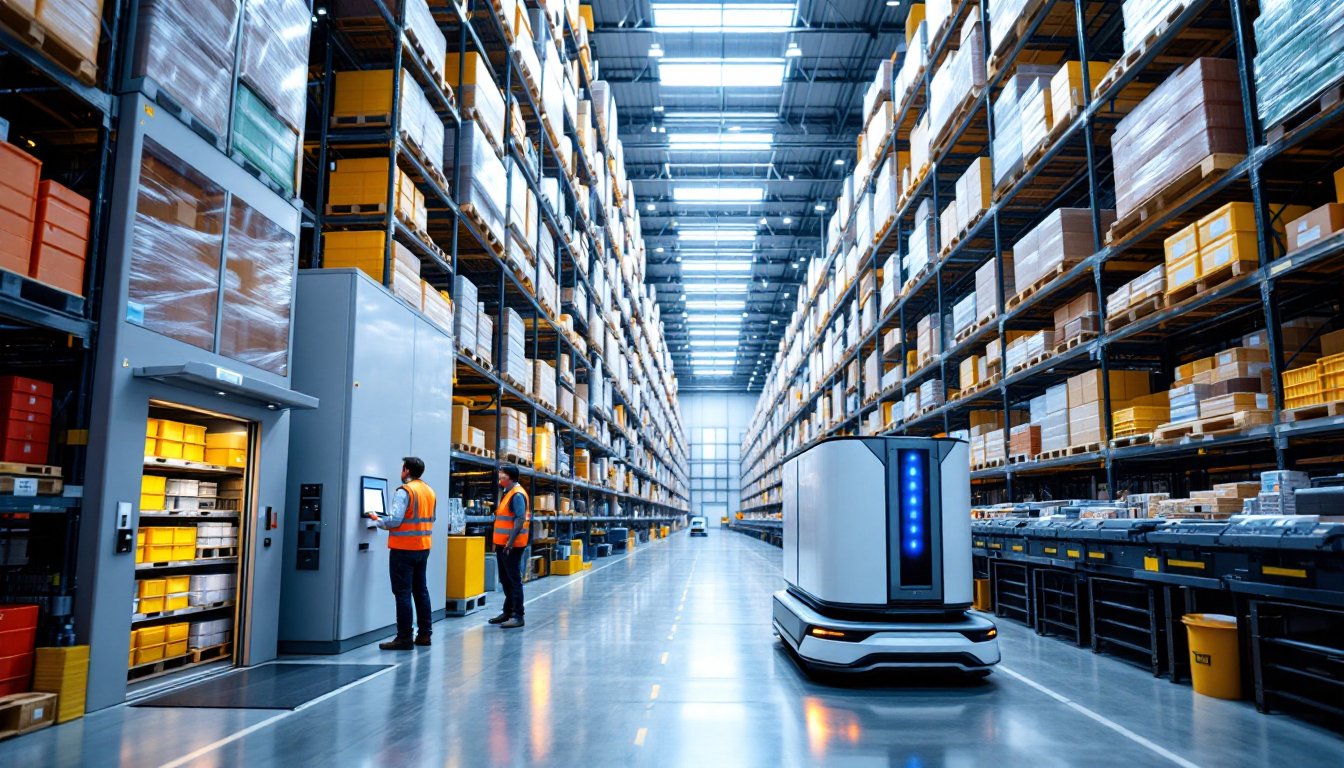
Automated warehouse storage solutions are integrated systems that use machinery, robotics, and software to store, retrieve, and manage inventory with minimal human intervention. Instead of workers walking aisles with pick lists, these systems bring products to stationary packing stations or use robotic shuttles to move pallets and bins on command.
The core components include storage structures (high-density racking, vertical towers, or grid-based matrices), material handling equipment (cranes, shuttles, conveyors, or robotic arms), and warehouse management software (WMS) that coordinates inventory locations, order routing, and system diagnostics in real time.
Automation handles three main tasks: storage (putting items away after receiving), retrieval (pulling items for orders), and inventory tracking (maintaining accurate bin-level data without manual cycle counts). Systems range from simple vertical carousels in a small parts room to multi-aisle AS/RS installations that manage hundreds of thousands of SKUs across a 100,000-square-foot facility.
These solutions differ from traditional warehouse equipment like forklifts or pallet jacks because they’re fixed infrastructure, once installed, they define the building’s workflow. That permanence demands careful planning but delivers consistent throughput and eliminates the variability of manual labor.
Key Types of Automated Storage Systems
AS/RS (Automated Storage and Retrieval Systems)
AS/RS installations use computer-controlled cranes or shuttles that travel on rails to store and retrieve pallets, cases, or totes from high-density racking. Unit-load AS/RS handles full pallets (typically 40″ × 48″ or 48″ × 40″) and operates in aisles 30 to 100 feet tall, using guided cranes with extendable forks. Mini-load AS/RS works with smaller totes or cartons, often in pharmaceutical, electronics, or e-commerce fulfillment where SKU velocity is high but item size is compact.
These systems excel in environments with predictable workflows and high-volume throughput. A single-aisle crane can execute 30–50 dual-command cycles per hour (one storage move and one retrieval move per trip), while shuttle-based systems scale to hundreds of cycles by adding more shuttles to the same racking structure.
AS/RS requires a dedicated building footprint and substantial upfront investment, often $1–3 million for a modest installation, including racking, cranes, software integration, and installation labor. The payback comes from floor space savings (up to 85% denser than manual racking) and labor reduction (one operator can monitor multiple aisles from a control station).
Permit requirements vary, but any installation involving structural racking over 20 feet or automated machinery typically requires local building and mechanical permits. Operators should also review OSHA standards for powered industrial trucks and automated equipment (29 CFR 1910.178 and related regulations).
Vertical Lift Modules and Carousel Systems
Vertical Lift Modules (VLMs) are enclosed towers, usually 12 to 40 feet tall, with trays stored on both sides of a central lift mechanism. An operator keys in a part number, and the system retrieves the correct tray and delivers it to an ergonomic access window at waist height. This “goods-to-person” approach eliminates walking, bending, and ladder climbing.
VLMs fit in tight spaces: a single unit occupies roughly 100 to 150 square feet of floor area but provides the storage equivalent of 500–1,000 square feet of static shelving. They’re popular in maintenance shops, electronics assembly, and healthcare supply rooms where SKU count is moderate (500–10,000 items) and picks per hour are in the dozens rather than hundreds.
Horizontal and vertical carousels rotate bins or shelves to bring items to the picker. Horizontal carousels resemble dry cleaner racks and work well for small, lightweight parts. Vertical carousels spin like a Ferris wheel and handle heavier items. Both systems can be clustered and controlled by a single workstation using pick-to-light indicators that guide the operator to the correct bin and quantity.
Carousels and VLMs typically cost $50,000 to $250,000 per unit depending on size, capacity, and software integration. Installation is faster than AS/RS, often a few days to a week, and they can be relocated if a facility moves, making them a more flexible investment for growing operations.
Top Benefits of Warehouse Automation
Space efficiency is the most immediate payoff. Automated systems use vertical height and eliminate wide aisles needed for forklifts. A facility running manual pallet racking at 10–12 feet can often retrofit to 30–50 feet with AS/RS, tripling usable pallet positions without expanding the building. For lease operations paying $6–12 per square foot annually, that density gain translates directly to cost savings or deferred expansion.
Labor cost reduction follows close behind. Automated retrieval cuts travel time and physical strain, allowing one worker to handle the throughput of three or four manual pickers. During labor shortages or in high-wage markets, this advantage accelerates ROI. But, automation doesn’t eliminate labor, it shifts roles from picking to system monitoring, exception handling, and maintenance.
Accuracy and inventory control improve dramatically. WMS-directed automation logs every put-away and retrieval with time stamps and bin assignments, reducing mis-picks and phantom inventory. Facilities often see pick accuracy climb from 97–98% (manual) to 99.7–99.9% (automated), which matters when shipping errors trigger chargebacks or customer churn.
Throughput consistency is another key benefit. Manual operations fluctuate with worker fatigue, shift changes, and turnover. Automated systems maintain steady cycle times shift after shift, making it easier to forecast capacity and meet SLA commitments during peak seasons.
Safety improves when forklifts and manual stacking are reduced. Fewer lift truck incidents, less repetitive strain injury, and elimination of high ladder work all contribute to lower workers’ comp claims and OSHA recordables. Many insurers offer premium reductions for facilities with documented automation and reduced manual material handling.
The trade-off is upfront capital and operational rigidity. Once an AS/RS is installed, reconfiguring it for a new product mix or relocating it is expensive. Systems also introduce single points of failure, if a crane or shuttle goes down, that aisle is offline until repairs are completed, so maintenance contracts and spare parts inventory become critical operational considerations.
How to Choose the Right Automated Storage Solution for Your Business
Start with a data-driven needs assessment. Calculate current and projected SKU count, average order lines per day, peak season multipliers, and inventory turns. A facility handling 500 SKUs with 200 order lines per day has very different needs than one managing 10,000 SKUs with 2,000 lines daily. Low-to-moderate volume operations often get the best ROI from VLMs or carousels, while high-volume fulfillment justifies AS/RS or shuttle systems.
Product characteristics matter as much as volume. Uniform pallet loads suit unit-load AS/RS. Mixed-case picking favors mini-load systems or goods-to-person robots. Slow-moving, high-value items (pharmaceuticals, aerospace components) work well in secure VLMs with controlled access logging. Fast-moving consumables might need shuttle-based systems with multiple access points to avoid bottlenecks.
Evaluate building constraints early. Ceiling height, floor load capacity (typically 250–500 psf for automated racking), column spacing, and door locations all affect feasibility. Retrofitting an older building with 18-foot ceilings limits vertical storage gains. A structural engineer should verify floor capacity before committing to dense racking, warehouse slabs are often designed for distributed loads, not concentrated crane rails.
Integration with existing systems is non-negotiable. The automation must talk to the warehouse management system, enterprise resource planning (ERP) software, and often transportation management systems (TMS) for outbound shipping. Proprietary systems that don’t support standard APIs (REST, SOAP, EDI) create long-term headaches. Ask vendors for reference sites with similar software stacks and request a proof-of-concept integration before final purchase.
Total cost of ownership (TCO) includes purchase price, installation, software licensing, annual maintenance contracts (typically 10–15% of system cost), and operator training. Budget for spare parts inventory, critical components like motors, encoders, and PLCs should be on-site to minimize downtime. Also factor in energy costs: automated systems run continuously and can add 50–150 kW of demand depending on system size.
Finally, plan for scalability. Modular systems that allow adding aisles, shuttles, or towers as volume grows offer more flexibility than monolithic installations. Some vendors offer leasing or robots-as-a-service (RaaS) models that reduce upfront capital and include maintenance, which can make sense for operations testing automation for the first time or expecting facility changes within five years.
Conclusion
Automated warehouse storage solutions deliver measurable gains in density, accuracy, and throughput, but they’re infrastructure investments that demand careful planning and honest assessment of volume, SKU profile, and facility constraints. The right system turns a space-constrained, labor-intensive operation into a scalable fulfillment engine, as long as the assignments gets done upfront and the technology matches the workflow, not the other way around.