
Finding quality landscape LED lighting installation isn’t just about searching online, it’s about knowing what separates competent installers from weekend warriors with wire strippers. LED technology has transformed outdoor lighting from a luxury add-on to an accessible, energy-efficient upgrade that enhances safety, curb appeal, and property value. Homeowners searching for “landscape LED lighting near me” face dozens of providers, but not all installers understand voltage drop calculations, proper transformer sizing, or how to design a lighting plan that won’t wash out in five years. This guide walks through what matters when selecting local professionals and equipment.
Table of Contents
ToggleKey Takeaways
- LED landscape lighting near you consumes 75-80% less energy than halogen alternatives and lasts 25,000-50,000 hours, making it a cost-effective upgrade that pays for itself within years.
- Qualified landscape LED lighting professionals should have industry certifications, on-site consultations, and written proposals that detail transformer specs, fixture models, wire gauges, and warranty terms—not phone quotes or generic estimates.
- Professional LED landscape lighting installations typically cost $2,500-$7,500 for residential projects with materials and labor split equally, plus minimal annual operating costs of $35-$50 for a 200-watt system.
- Proper design layering (ambient, task, and accent lighting) with correct voltage drop calculations, beam angles, and fixture placement prevents over-lighting and ensures fixtures at end-of-run receive adequate power.
- Verify local contractors carry general liability and workers’ compensation insurance, manage their own warranty claims with parts in stock, and use weather-resistant connectors and direct-burial cable rather than wire nuts.
Why LED Technology Dominates Modern Landscape Lighting
LED fixtures have effectively replaced halogen and incandescent bulbs in landscape applications for measurable reasons. LEDs consume 75-80% less energy than equivalent halogen bulbs, a 20-watt LED produces light comparable to a 75-watt halogen. That efficiency compounds over systems with 15-30 fixtures running 8-10 hours nightly.
Lifespan matters just as much. Quality LED landscape fixtures last 25,000-50,000 hours compared to 2,000-4,000 hours for halogens. In practical terms, that’s 10-15 years of operation before replacement versus 1-2 years. Fewer bulb changes means less ladder time and fewer service calls, which matters for fixtures mounted twelve feet up in trees.
LEDs also run cooler, typically under 150°F at the junction versus 500°F+ for halogens. Lower heat reduces fire risk near mulch or dried vegetation and allows fixtures to be installed closer to plants without scorching foliage. They’re more durable, too, with solid-state construction that handles vibration and minor impacts better than filament bulbs.
Color temperature consistency has improved dramatically since early LEDs. Modern landscape fixtures offer 2700K-3000K warm white that mimics traditional incandescent glow, avoiding the harsh blue-white cast of first-generation LEDs. Some systems include tunable color or RGB options, though most designers stick with warm tones for residential applications.
Dimmability and control integration matter for serious installations. LED-compatible transformers and controllers allow smooth dimming without flicker, and many systems now integrate with smart home platforms or astronomic timers that adjust for seasonal sunset variations.
How to Find Qualified Landscape Lighting Professionals in Your Area
Start with specialty landscape lighting contractors, not general electricians or landscapers who install lighting as a side service. Dedicated lighting professionals understand design principles, uplight spacing, beam angles, fixture placement for minimizing glare, that generalists often miss.
Check for industry certifications like Association of Outdoor Lighting Professionals (AOLP) membership or manufacturer-specific training credentials. These aren’t legal requirements, but they indicate someone has invested in education beyond YouTube tutorials. Ask how long they’ve specialized in landscape lighting specifically, not just “electrical work.”
Request local references and drive by completed installations at night if possible. Photos can be staged or edited: seeing how a system actually performs after dark reveals light uniformity, glare issues, and whether fixtures are already showing rust or misalignment.
Insurance matters. Verify the contractor carries both general liability and workers’ compensation insurance. Landscape lighting work involves trenching, drilling near irrigation lines, and working around underground utilities. A contractor without proper coverage leaves the homeowner exposed if someone gets hurt or a gas line gets nicked.
Get detailed written proposals that specify:
- Transformer size and brand (not just “transformer included”)
- Fixture models with wattages and beam angles
- Wire gauge and run lengths (14-gauge vs. 12-gauge vs. 10-gauge affects voltage drop)
- Warranty terms on both equipment and labor
- Timeline and payment schedule
Avoid contractors who push for large upfront deposits (30% maximum is reasonable) or who won’t provide a written warranty. Most reputable installers offer at least a 2-3 year labor warranty and help manufacturer warranties on fixtures, which typically run 5-10 years for quality LED products.
What to Look for in Local LED Landscape Lighting Providers
A quality provider starts with an on-site consultation, not a phone quote. Lighting design requires evaluating the property after dark to understand existing ambient light, identify focal points, and assess power source locations. Anyone quoting a system without a site visit is guessing.
Ask about their design process. Professional designers consider:
- Layering (ambient, task, and accent lighting rather than just flooding everything)
- Beam spread selection (narrow spots for uplighting trees, wide floods for walls)
- Voltage drop calculations to ensure fixtures at the end of runs receive adequate power
- Dark sky principles to minimize light pollution and glare
Equipment selection should match the application. Cast brass or copper fixtures cost more upfront but resist corrosion far better than aluminum or plastic in wet climates. Powder-coated aluminum works well in dry regions. Avoid contractors who only offer one fixture line, that suggests they’re locked into a distributor relationship rather than selecting the best product for each situation.
Transformer sizing is critical. A quality installer specs transformers at 80% of maximum capacity to allow for future expansion and reduce heat stress. A system needing 240 watts should have at least a 300-watt transformer, not a 200-watt unit maxed out. Multi-tap transformers allow voltage adjustment to compensate for line loss on longer runs.
Warranty support matters long-term. Ask who handles warranty claims, some contractors install then disappear, leaving homeowners to navigate manufacturer service alone. Established local companies typically manage warranty issues and keep common parts in stock for faster repairs.
Look for contractors who mention wire connectors with dielectric grease rather than twist-on wire nuts (which corrode in wet environments) and who use direct-burial-rated cable, not standard lamp cord. These details separate professionals from hacks.
Popular LED Landscape Lighting Options for Your Property
Pathway and Walkway Lighting
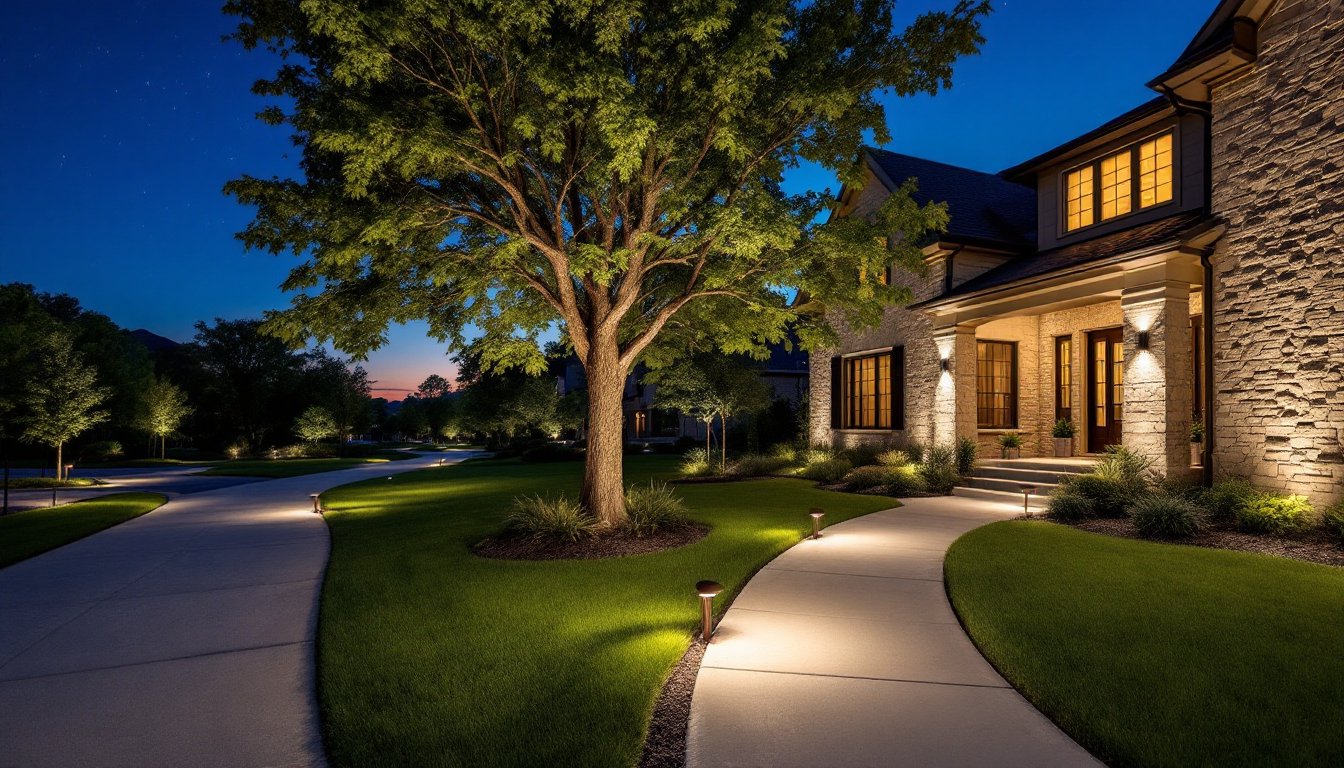
Path lights typically mount 18-24 inches tall and space 8-10 feet apart, depending on light output and beam spread. LED path lights in the 3-5 watt range provide adequate illumination for safe navigation without over-lighting. Look for fixtures with downward-facing shields or louvers to minimize glare, nobody wants to stare directly into bulbs while walking.
Flush-mounted well lights offer an alternative where protruding fixtures might get damaged by mowers or foot traffic. Recessed into the ground with grated covers, they direct light upward or across walkways. These require more installation effort (coring holes in hardscape or soil) but create clean sightlines.
Step lighting prevents trips and falls on stairs and grade changes. Hardscape lights install directly into risers during construction, or surface-mount fixtures can attach to existing steps. Building codes in many jurisdictions now require illumination at grade changes exceeding 12 inches, verify local requirements.
Accent and Uplighting Features
Uplights highlight architectural elements, trees, and specimen plants. For trees, position fixtures 12-24 inches from the trunk, aiming upward to wash light through the canopy. Narrow 10-15 degree beam angles work for tall, narrow trees like Italian cypress: wider 30-60 degree beams suit spreading oaks or architectural facades.
Wattage varies by subject size. A 3-watt LED suffices for small shrubs or garden art, while mature trees may need 7-12 watts depending on height and density. Over-lighting is a common rookie mistake, landscape lighting should create drama and depth, not look like a car dealership.
Wall wash lights graze vertical surfaces to reveal texture on stone, brick, or stucco. Position them 12-18 inches from the wall, aiming parallel to the surface. Some fixtures include integral shields to prevent spill light into windows or neighboring properties.
Downlights (moonlighting) mount high in trees and aim downward to simulate natural moonlight filtering through branches. This technique requires fixtures with glare shields and careful positioning to avoid direct viewing angles from ground level.
Cost Considerations for Professional LED Landscape Lighting Installation
Professional LED landscape lighting typically costs $2,500-$7,500 for most residential projects, with high-end designs exceeding $10,000. Price breaks down into materials (40-50%), labor (40-50%), and design/overhead (10-20%).
Fixture costs range from $40-$150 each for quality residential LEDs. Brass fixtures with integrated LEDs run higher: aluminum with replaceable LED modules cost less. Figure 12-20 fixtures for a modest front-yard design, more for complete property lighting.
Transformers run $200-$800 depending on capacity. A 300-watt multi-tap transformer suitable for most small-to-medium systems costs around $350-$450. Systems over 500 watts may need multiple transformers or higher-capacity commercial units.
Labor varies by installation complexity. Simple surface-mount installations cost less than projects requiring trenching through hardscape, directional boring under driveways, or working around established landscaping. Expect $75-$150 per hour for qualified installers, with most projects taking 2-4 days.
Permits rarely apply for low-voltage landscape lighting (12V systems), but local codes vary. High-voltage feeds (120V from house to transformer) might require electrical permits if extending service. Check with local building departments.
Operating costs for LED systems are minimal, a 200-watt system running 8 hours nightly costs roughly $35-$50 annually at average electricity rates. Compare that to $180-$240 yearly for equivalent halogen systems.
Maintenance includes occasional fixture cleaning, checking wire connections, and transformer inspection. Budget $150-$300 annually for a professional service visit if not handling it personally. Quality LED systems need minimal intervention, most service calls involve adjusting fixtures that have shifted or adding zones for new landscaping.
Financing options exist through some contractors or home improvement lenders. Treat landscape lighting like any outdoor investment, quality installation pays off in longevity and performance. Cheap installations fail within 3-5 years: professional LED systems run 15+ years with minimal fuss.