
Outdoor lighting does more than flip a switch when the sun goes down, it shapes how a home feels after dark, keeps walkways safe, deters unwelcome visitors, and turns a backyard into usable square footage well past dinner. But picking the right fixtures means understanding what each type actually does, where it works best, and how to wire or install it without creating a code violation or an eyesore. Whether someone’s tackling a front path, uplighting a oak tree, or adding motion-activated floods by the garage, the right outdoor lighting setup balances function, safety, and a bit of intentional design.
Table of Contents
ToggleKey Takeaways
- Outdoor lighting options serve three essential functions—safety, security, and usability—while significantly enhancing curb appeal and property value when chosen thoughtfully.
- Path lights spaced 6–10 feet apart and low-voltage landscape lighting systems offer DIY-friendly, code-compliant solutions that don’t require expensive conduit burial.
- Layer different fixture types by purpose: path lights for walkways, spotlights for trees, wall sconces for doorways, and motion-activated floods for security to prevent over-lighting and dead zones.
- Maintain warm color temperatures (2700K–3000K) for residential outdoor lighting, avoid aiming lights at windows, and always use GFCI-protected outlets to prevent safety hazards and code violations.
- Smart outdoor lighting with geofencing and scheduling adds convenience, while solar options work best in full-sun locations but require quarterly panel cleaning and realistic battery-life expectations.
Why Choosing the Right Outdoor Lighting Matters
Outdoor lighting serves three critical roles: safety, security, and usability. A poorly lit walkway is a twisted ankle waiting to happen, especially on uneven pavers or steps. Motion-sensor floods near entry points reduce break-in risk, most burglars skip homes with visible exterior lighting. And ambient lighting on a deck or patio extends living space into evening hours, making the investment in that outdoor furniture actually worth it.
Beyond function, lighting affects curb appeal and property value. Thoughtful landscape lighting can highlight architectural features, mature trees, or garden beds, creating depth and visual interest after dark. Poor choices, glaring floods aimed at neighbors’ windows, mismatched color temperatures, or tangled low-voltage wire, do the opposite.
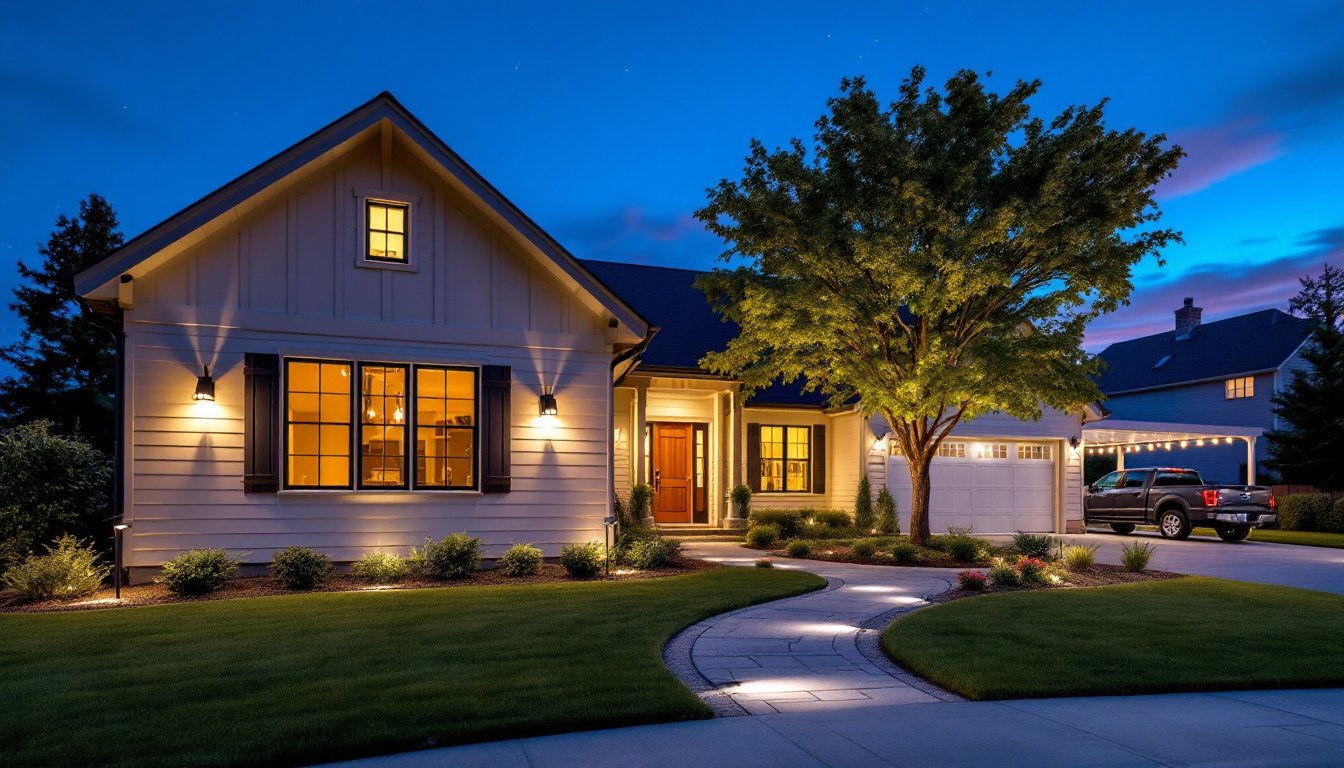
Different zones need different solutions. Path lights guide foot traffic. Spotlights and well lights accent plantings. Wall sconces frame doorways. Floodlights cover driveways and side yards. Mixing fixture types based on purpose prevents both over-lighting and dead zones, and keeps the project from becoming a utility bill nightmare or a code compliance headache.
Path and Walkway Lighting for Safety and Curb Appeal
Path lights do one job well: they mark edges and reveal changes in grade so people don’t trip. Standard stake-mounted path lights stand 12–24 inches tall and space every 6–10 feet along walkways, depending on lumen output and beam spread. Low-voltage systems (12V or 24V) are the go-to for residential installs, they’re safer to work with, don’t require conduit burial in most jurisdictions, and run off a plug-in transformer.
Materials and styles range from plastic solar stakes (fine for temporary or budget setups) to cast aluminum, copper, or stainless steel fixtures that hold up to freeze-thaw cycles and lawn equipment. Look for wet-rated or damp-rated labels: wet-rated fixtures handle direct rain and sprinkler spray.
For a cleaner look, consider recessed step lights or hardscape lights embedded in retaining walls, stair risers, or paver edges. These require planning during construction but eliminate tripping hazards and mower strikes. Most use 1–3 watt LEDs and cast a soft wash rather than a spotlight.
Installation tips:
- Run low-voltage cable in a shallow trench (6–8 inches is typical for low-voltage: check local codes).
- Use a transformer sized for total wattage plus 20% overhead. A 200-watt transformer can handle roughly 160 watts of fixtures.
- Avoid daisy-chaining too many lights on one run, voltage drop causes dimming at the far end. Split into multiple runs if the path exceeds 50–75 feet.
Always connect to a GFCI-protected outlet. If tapping into an existing exterior receptacle, confirm it’s on a dedicated circuit or has capacity to spare.
Landscape and Garden Lighting to Highlight Your Yard
Landscape lighting brings depth and drama by playing with uplighting, downlighting, and wash lighting. It’s less about flooding the yard with lumens and more about selective emphasis, what deserves attention after dark?
Spotlights and well lights work for uplighting trees, architectural columns, or specimen plants. A 3–5 watt LED spot at the base of a mature tree trunk creates striking shadow patterns on branches. In-ground well lights sit flush with soil or mulch: they’re durable but need occasional cleaning to prevent dirt buildup over the lens.
Downlighting (sometimes called moon lighting) involves mounting fixtures in trees or on structures to cast light downward, mimicking natural moonlight. Use shielded bullet lights on branches or eaves to avoid glare. This technique works well over patios, garden beds, or seating areas.
Wash lights graze walls, fences, or hedges with a wide, even beam. They soften hard edges and provide ambient fill without harsh shadows.
Key considerations:
- Color temperature: Stick to 2700K–3000K (warm white) for residential landscapes. Cooler temps (4000K+) feel commercial.
- Beam angle: Narrow spots (10–25°) for tall trees: wide floods (40–60°) for shrub beds or walls.
- Fixture placement: Avoid aiming lights directly at windows, yours or the neighbors’. Angle beams away from sightlines and use shields or louvers to control spill.
Low-voltage landscape lighting typically uses the same transformer setup as path lights. For larger properties or commercial-grade installs, line-voltage (120V) systems offer more power and longer runs but require burial in conduit per NEC standards and often a permit.
Deck, Patio, and Outdoor Living Space Lighting
Outdoor living spaces need task lighting for cooking and dining, ambient lighting for mood, and safety lighting for steps and edges. Layering these types creates a functional, inviting setup.
Deck post cap lights mount on 4×4 or 6×6 posts and provide gentle downward illumination. They’re easy retrofits, most clamp or screw onto existing posts, and available in solar or low-voltage versions. Expect 10–30 lumens per cap: they won’t light a whole deck but they mark boundaries.
Recessed deck lights install flush in deck boards, stair risers, or under railings. They’re nearly invisible during the day and create a modern, clean look at night. Use marine-grade stainless steel or composite-compatible fixtures to prevent corrosion and wood rot. Plan wire routing during deck framing: fishing cable later is miserable.
String lights and bistro lighting offer ambient fill and a casual vibe. Use commercial-grade outdoor string lights with replaceable bulbs and 16- or 18-gauge wire, the cheap big-box sets with molded sockets fail within a season. Hang with stainless cable and turnbuckles, not staples or nails. If stringing more than 50 feet, check the manufacturer’s max run length to avoid overload.
For patios, wall sconces flanking a door or pergola post lights provide architectural interest and general illumination. Mount sconces 5½–6 feet off the ground for even coverage and to avoid head bumps.
Grilling and prep areas benefit from directional task lights. A small LED flood or adjustable spotlight mounted on a pergola beam or nearby wall makes seasoning a steak much easier.
All outdoor living space fixtures should be wet-rated. If installing new electrical, run on a GFCI-protected circuit and use weatherproof boxes and covers. Retrofitting often means tapping into an existing exterior outlet, just confirm the circuit can handle the additional load.
Security and Flood Lighting for Protection
Security lighting prioritizes coverage and deterrence over aesthetics. Motion-activated floodlights are the workhorse, typically dual-head LED floods with adjustable sensors that detect movement within 30–70 feet and trigger 1,000–3,000 lumens for 1–10 minutes.
Mount floods 8–10 feet high, angled down at 20–30° to cover entry points, driveways, or side gates. Avoid aiming directly at streets or neighbors’ yards, light trespass violations can result in code enforcement complaints. Use adjustable sensitivity and timer settings to reduce false triggers from animals, wind-blown branches, or passing cars.
Dusk-to-dawn lights with photocell sensors turn on automatically at sunset and off at sunrise. They’re useful for consistent coverage in alleys, back gates, or detached garages but lack the deterrent surprise of motion activation. Combine both for layered security.
Camera-integrated lights merge motion detection, LED floods, and Wi-Fi cameras into one fixture. They’re convenient but may require firmware updates, solid Wi-Fi signal at the install location, and subscription services for cloud storage.
Wiring and installation:
- Most security floods run on 120V line voltage. If replacing an existing fixture, it’s often a direct swap. New installs require running 14/2 or 12/2 NM-B cable (Romex) from a breaker panel or junction box, typically involving attic or crawl space access.
- Use a weatherproof junction box and make sure all connections are inside the box, not dangling in the fixture canopy.
- Always kill power at the breaker and verify with a voltage tester before touching wires.
For renters or temporary setups, plug-in motion floods are available but require an exterior GFCI outlet within cord reach.
Smart and Solar Outdoor Lighting Solutions
Smart outdoor lighting integrates with home automation systems, allowing remote control, scheduling, dimming, and color changes via smartphone apps or voice assistants. Most smart fixtures connect via Wi-Fi, Zigbee, or Z-Wave. Wi-Fi fixtures work standalone: Zigbee and Z-Wave require a compatible hub (SmartThings, Hubitat, etc.).
Common smart options include bulbs that screw into existing outdoor sockets, integrated smart flood or path lights, and plug-in transformers with app control for low-voltage systems. Benefits include geofencing (lights turn on when someone arrives home), automated scheduling, and integration with security cameras or door sensors.
Considerations:
- Firmware updates are essential: unsupported devices become security risks.
- Wi-Fi signal strength matters, exterior walls and distance degrade connectivity.
- Battery-powered smart lights exist but require regular charging or replacement.
Solar outdoor lighting eliminates wiring and taps into free energy, making it ideal for remote areas, rentals, or quick installs. Solar path lights, spotlights, and string lights use photovoltaic panels to charge onboard batteries during the day and power LEDs at night.
Realistic expectations:
- Solar works best in full-sun locations. Shaded yards or northern climates in winter see reduced performance.
- Budget solar lights (under $15 each) often use low-capacity batteries and dim LEDs. They’re fine for accent but not primary lighting.
- Quality solar fixtures (commercial-grade panels, lithium batteries, 100+ lumens) cost $40–$100+ per unit but deliver reliable output for 6–8 hours per charge.
Solar doesn’t mean maintenance-free. Panels collect dust, pollen, and snow: clean them quarterly. Batteries degrade over 2–4 years and may need replacement.
For hybrid needs, some systems combine solar charging with plug-in backup, ensuring lights function even after cloudy stretches.
Conclusion
Outdoor lighting isn’t one-size-fits-all. Matching fixture type to function, path lights for safety, spots for landscapes, floods for security, creates a cohesive, effective system. Low-voltage setups offer DIY-friendly installs: line-voltage delivers power for large areas. Smart and solar options add convenience and flexibility, as long as expectations stay realistic. Plan the layout on paper, size transformers correctly, respect code requirements, and don’t skip GFCI protection. Done right, outdoor lighting turns a dark yard into a safer, more usable extension of the home.