
A pool deck without lighting is like a stage without spotlights, functional at best, but missing half its potential. Proper illumination extends usability well past sunset, prevents trips and falls, and transforms an ordinary backyard pool into a destination. Whether someone’s planning evening swims, late-night gatherings, or just wants to enjoy the view from inside, the right lighting setup makes all the difference. This guide walks through the most effective lighting types, placement strategies, and installation requirements to create a safe, attractive pool deck that works after dark.
Table of Contents
ToggleKey Takeaways
- Proper lighting around pool deck is a safety requirement mandated by building codes that prevents slip-and-fall hazards and deters unauthorized access to the pool area.
- LED strip lights and in-deck flush-mount fixtures are the most effective lighting types, with LED strips rated IP67 or IP68 for wet locations and in-deck lights spaced 6 to 8 feet apart for even coverage.
- Strategic placement of pool deck lighting should include perimeter illumination every 8 to 10 feet, extra attention to corners and steps, and layered light sources that combine safety uplights with ambient lighting from railings and landscaping.
- Warm white color temperature (2700K to 3000K) creates a relaxed resort-like atmosphere ideal for entertaining, while 3500K to 4000K neutral white offers better visibility for task areas and safety-focused installations.
- Pool lighting installations must comply with NEC Article 680 electrical codes and GFCI protection requirements; low-voltage systems (12V/24V) are safer and easier to install than line-voltage fixtures, but always obtain local permits before starting any electrical work.
Why Proper Pool Deck Lighting Matters
Pool deck lighting isn’t optional, it’s a safety requirement and a code issue in many jurisdictions. The International Residential Code (IRC) and local building codes typically mandate illumination around pools to prevent accidents, especially near steps, edges, and transition zones between deck and water.
Adequate lighting reduces slip-and-fall hazards on wet surfaces. A well-lit perimeter helps swimmers judge distances and locate pool edges, ladders, and steps. It also deters unauthorized access when the pool isn’t in use, particularly important for families with young children.
Beyond safety, thoughtful lighting extends the pool’s functional hours. Evening swims become feasible without harsh overhead floods. Ambient lighting creates atmosphere for entertaining, turning the deck into usable outdoor living space rather than a daytime-only feature.
Finally, property value benefits from quality outdoor lighting. A professionally lit pool area signals upkeep and enhances curb appeal, especially during evening showings. It’s an investment that pays dividends in both daily use and resale.
Best Types of Lighting for Pool Decks
Choosing the right fixture type depends on the deck material, desired effect, and how much retrofitting the homeowner’s willing to tackle. Here are the most common and effective options.
LED Strip Lights and Tape Lighting
LED strip lights offer flexibility and low voltage operation, making them ideal for accent work along railings, under coping, or beneath bench seating. Most run on 12V or 24V systems, which are safer around water and easier to install than line-voltage fixtures.
Look for strips rated IP67 or IP68 for wet locations, they’re fully sealed against moisture and submersion. Standard IP65-rated strips work for protected areas like under handrails but won’t survive direct water exposure.
Installation typically involves adhering the strip to a clean, dry surface with the included adhesive backing, though adding aluminum channels provides better heat dissipation and a cleaner finished look. Channels also protect the strip from foot traffic and UV degradation.
One caution: cheap LED strips fade and fail quickly. Stick with products that specify lumen output per foot (at least 100 lumens/ft for functional lighting) and CRI (Color Rendering Index) above 80 to avoid sickly green or blue tints.
In-Deck and Flush-Mount Fixtures
In-deck lights mount flush with the walking surface, providing unobtrusive illumination without trip hazards. They’re the go-to choice for concrete, pavers, or composite decking.
These fixtures require wet location ratings (suitable for direct water contact) and must be installed during deck construction or through careful retrofitting. For concrete decks, that means core-drilling holes and running conduit before pouring or cutting into existing slabs, not a trivial task.
Most in-deck fixtures use MR16 or GU10 LED bulbs in the 3W to 5W range, producing 200–400 lumens each. Space them 6 to 8 feet apart along pathways and pool edges for even coverage without harsh shadows.
Pay attention to beam angle. Narrow spots (15–25 degrees) create dramatic pools of light but require more fixtures. Wide floods (40–60 degrees) spread light efficiently but can cause glare if aimed poorly.
For wood or composite decks, look for fixtures designed to mount between deck boards. They drop into routed recesses or attach to joists from below, avoiding the need to drill through the deck surface. Brands like Trex and TimberTech make proprietary systems that integrate cleanly with their decking products.
Strategic Placement for Safety and Ambiance
Random fixture placement wastes money and creates dark spots. A good lighting plan addresses both safety and aesthetics systematically.
Start with perimeter lighting at 8- to 10-foot intervals around the pool edge. This defines the boundary and prevents accidental falls. Focus extra attention on corners, steps, and ladders, anywhere someone transitions elevation or enters/exits the water.
Illuminate walkways and pathways leading to and from the pool. If the deck connects to a patio, gate, or house entrance, light the entire route. A common mistake is lighting the pool beautifully while leaving the approach in darkness, which creates a safety hazard and forces guests to navigate blind.
Consider layering light sources. Combine in-deck uplights for safety with softer strip lighting under railings or behind planters for ambiance. Overhead string lights or post-mounted fixtures can fill in the middle zone without harsh downlighting directly onto the water.
Avoid aiming bright fixtures directly at the pool surface, which creates glare and makes it difficult to see swimmers. Instead, use indirect lighting or aim fixtures at surrounding surfaces, deck, walls, or landscaping, that reflect light back onto the pool area.
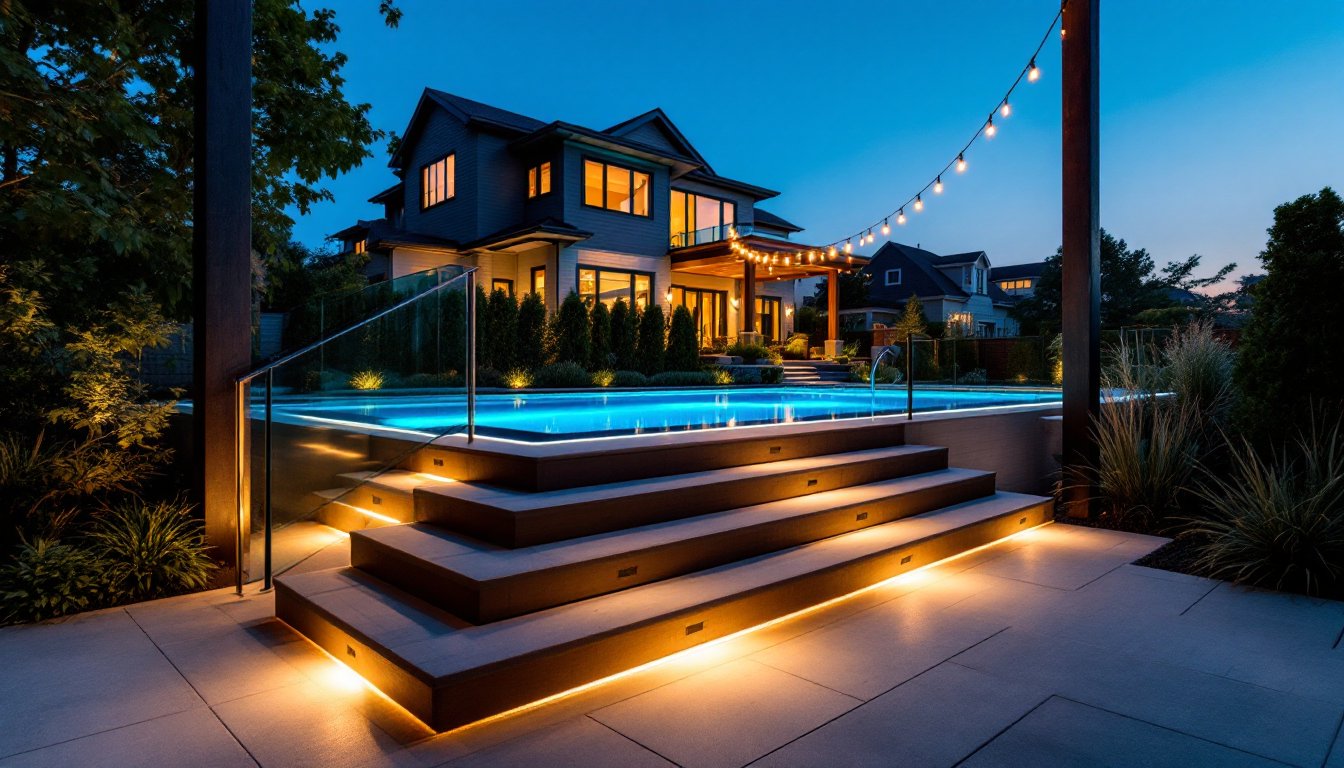
For multi-level decks or tiered designs, light each level transition clearly. Steps, risers, and elevation changes are prime accident zones, especially when wet. Riser lights mounted on stair faces or nosing strips with integrated LEDs are purpose-built for this.
Finally, think about sightlines from inside the house. Many homeowners want to enjoy the lit pool from a family room or kitchen window. Position fixtures to create an attractive view from those vantage points, not just from poolside.
Design Considerations and Color Temperature
Color temperature dramatically affects mood and visibility. Measured in Kelvin (K), it ranges from warm amber tones (2700K) to cool blue-white (5000K+).
For pool decks, 2700K to 3000K (warm white) creates a relaxed, resort-like feel. It’s flattering to skin tones and blends well with landscape lighting. Most homeowners prefer this range for evening entertaining.
3500K to 4000K (neutral white) offers better visibility and color accuracy, useful for task areas like outdoor kitchens adjacent to the pool or for homeowners who prioritize safety over ambiance.
Avoid cool white (5000K+) unless there’s a specific design reason. It feels institutional and harsh, washing out colors and creating an unwelcoming atmosphere.
Many modern LED fixtures offer tunable white or RGB color-changing options. While fun for occasional parties, colored lighting loses its novelty quickly. If going this route, ensure the system defaults to functional white light and that color modes are truly optional, not the primary feature.
Dimming capability extends versatility. A system that’s too bright for quiet evenings but too dim for active swimming becomes a compromise. Adding dimmers, whether wall-mounted, smart-home integrated, or via remote, lets users adjust intensity to match the occasion.
Material finishes matter too. Brushed stainless steel or bronze fixtures blend with most deck styles and weather gracefully. Avoid shiny chrome around pools: it shows water spots and corrosion quickly. For coastal areas or saltwater pools, specify marine-grade or 316 stainless to prevent pitting and rust.
Installation Tips and Electrical Requirements
Pool lighting falls under strict electrical codes due to water proximity. The National Electrical Code (NEC) Article 680 governs pool installations, requiring GFCI protection for all receptacles and lighting within the pool area.
Most jurisdictions require permits for any electrical work involving new circuits or line-voltage wiring. Low-voltage systems (12V/24V) often have more relaxed requirements, but always check local codes before starting.
For low-voltage LED systems, a transformer steps down 120V household current to safe operating voltage. Install the transformer in a dry, accessible location, not tucked under a deck where moisture collects. Size the transformer to handle at least 80% of its rated capacity to prevent overheating (e.g., a 100W transformer should power no more than 80W of fixtures).
Run wiring in conduit even if code doesn’t require it. Exposed wiring around pools gets bumped, stepped on, and soaked. PVC conduit is inexpensive and protects against physical damage and moisture intrusion. For underground runs, use UF-B (underground feeder) cable in conduit or direct-bury rated wire at the code-required depth (usually 18 inches minimum, deeper for higher voltages).
Wire gauge matters for voltage drop, especially on low-voltage runs. For 12V systems, use 12 AWG wire for runs under 30 feet and 10 AWG for longer distances. Undersized wire causes dimming and premature LED failure.
If the project involves line-voltage fixtures (120V), hire a licensed electrician. Improper installation around water isn’t just a code violation, it’s a serious shock and electrocution hazard. The cost of professional installation is minor compared to the liability risk.
When retrofitting existing decks, plan wire routes carefully to minimize visible conduit and patching. Sometimes running wires through the deck substructure or beneath pavers is possible: other times, surface-mount conduit is the only option. Mock up the installation first to see what works visually.
Safety gear for DIY installation includes safety glasses (when drilling), gloves (handling wire and fixtures), and a voltage tester (confirming power is off). For any overhead work or ladder use, have a second person on site.