
The entryway sets the tone for an entire home, but when space is tight, poor lighting can make it feel cramped, dark, and unwelcoming. Small foyers demand strategic lighting choices that maximize every square foot without overwhelming the space. From ceiling fixtures that don’t steal headroom to wall sconces that add ambiance without floor clutter, the right lighting transforms a narrow hallway into a bright, functional entry. Smart fixture placement, layered light sources, and reflective surfaces work together to open up even the tightest corners. This guide breaks down practical, achievable lighting solutions that deliver both style and function, no vague inspiration, just installations that work.
Table of Contents
ToggleKey Takeaways
- Small entryway lighting ideas must balance function and style, with strategic fixture placement delivering 200-300 lumens per square foot in task areas to ensure safety and usability.
- Wall sconces and pendant lights maximize vertical space in tight entries without consuming floor or ceiling room, with sconces mounted at 60-66 inches and pendants positioned 6.5-7 feet high for visual impact.
- Mirrors and reflective surfaces redirect existing light to amplify perceived brightness, making them essential for small foyers when positioned opposite or adjacent to light sources rather than facing them directly.
- Layered lighting that combines ambient (ceiling fixtures), task (sconces or puck lights), and accent light (uplights or strips) creates flexibility and depth even in entries under 25 square feet.
- Smart lighting solutions like motion sensors, smart bulbs, and battery-powered LED strips provide energy efficiency and convenience with minimal installation effort, making them ideal for renters and quick upgrades.
- Most small entryway lighting upgrades cost $75-300 per fixture and take under an hour to install, delivering measurable returns through improved home value and daily usability.
Why Lighting Matters in Small Entryways
Lighting in a small entryway isn’t just decorative, it’s functional infrastructure that affects safety, perceived space, and home value. A poorly lit entry creates tripping hazards, makes coat hooks and shoe storage hard to use, and broadcasts a negative first impression to visitors.
Small spaces amplify lighting mistakes. A single overhead bulb casts harsh shadows and flattens dimensions, making the area feel smaller. Insufficient lumens force occupants to fumble with keys or miss details when checking appearance before leaving.
From a code perspective, the International Residential Code (IRC) requires at least one switched lighting outlet in hallways and entryways. That’s a minimum, not a target. For practical use, aim for 200-300 lumens per square foot in task areas near doors and mirrors, with softer ambient light filling the rest.
Good lighting also affects resale. Real estate agents consistently note that bright, well-lit entries photograph better and score higher in showings. Conversely, dim entryways signal deferred maintenance and lack of attention to detail. For a relatively small investment, most fixture upgrades run $75-$300 per unit depending on finish and features, homeowners gain daily usability and measurable return when selling.
Maximize Vertical Space with Wall Sconces and Pendant Lights
In tight entryways, vertical space is underused real estate. Wall sconces mount at eye level (typically 60-66 inches from the floor to the center of the fixture) and free up ceiling and floor space while delivering targeted light exactly where it’s needed.
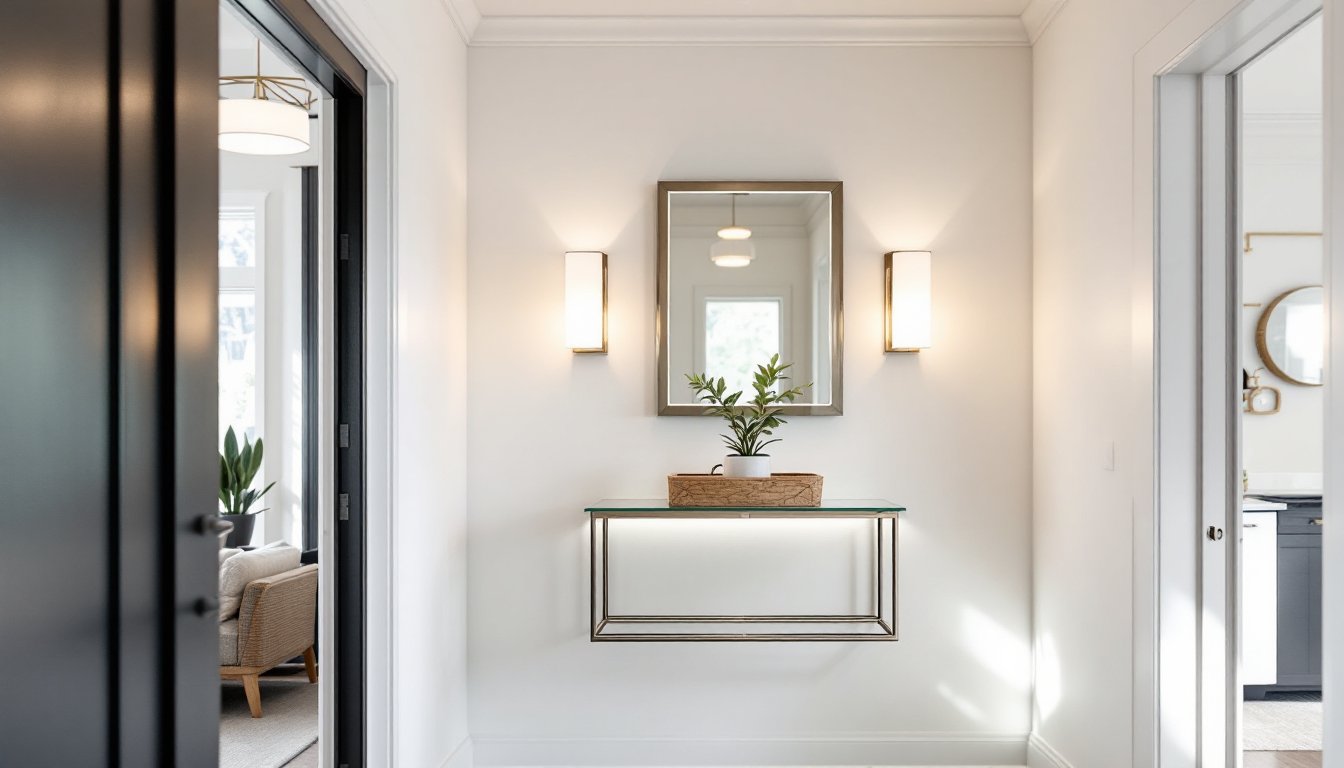
Sconces work best in pairs flanking a mirror or console table, creating balanced illumination without dead zones. For narrow hallways under 4 feet wide, single sconces every 6-8 feet provide adequate coverage. Choose fixtures with opaque or frosted shades to prevent glare at eye level: clear glass bulbs create uncomfortable hot spots in confined spaces.
Wiring is the main hurdle. Sconces require junction boxes, which means either opening walls or surface-mounting conduit, both permit-required tasks in most jurisdictions. If the entryway shares a wall with a room that already has power, fishing wire is straightforward. If not, battery-operated LED sconces now offer 500-800 lumens output and last 2-3 years on a charge, eliminating electrical work while still delivering serious light.
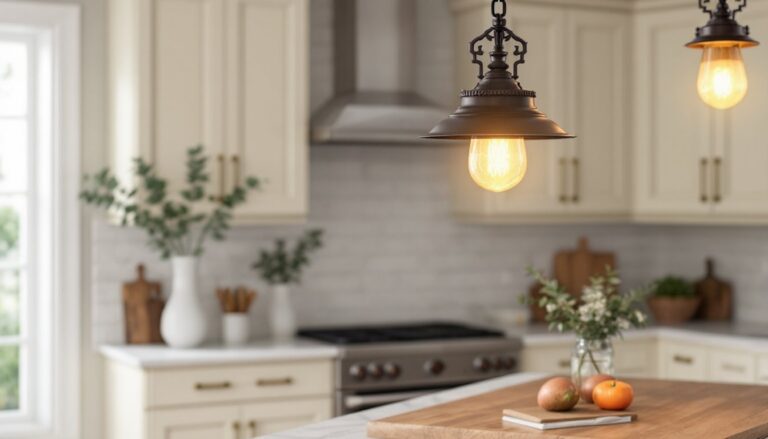
Pendant lights reclaim vertical space differently. In entryways with 8-foot or higher ceilings, a single pendant hung 6.5-7 feet from the floor (to allow clearance for tall occupants and carried items) draws the eye upward and creates the illusion of height. Mini-pendants with 6-8 inch diameter shades scale appropriately for small spaces. Avoid oversized drum or globe pendants: anything over 12 inches diameter visually overwhelms a compact entry.
Install pendants on a dimmer switch, a $15-25 upgrade that transforms a single fixture into ambient, task, or accent light depending on time of day. For renters or quick upgrades, plug-in swag kits convert hardwired pendants into fixtures that hook to the ceiling and plug into existing outlets, though they do leave visible cord.
Creative Flush Mount and Semi-Flush Ceiling Fixtures
Low ceilings and small footprints make flush mount and semi-flush mount fixtures the default choice for many entryways. But “default” doesn’t mean boring. Modern designs incorporate LED edge-lighting, geometric metalwork, and layered glass that deliver visual interest within a 4-6 inch ceiling profile.
Flush mounts sit directly against the ceiling, ideal for spaces under 8 feet. Semi-flush models drop 4-12 inches on a short stem or chain, offering more design flexibility in standard-height entries. Either style should cover the existing junction box (typically 4-inch round or octagonal boxes) without gaps.
When selecting fixtures, match the diameter to room size. A common rule: add the room’s length and width in feet, then convert to inches. A 5-foot by 6-foot entryway suggests an 11-inch diameter fixture. Overshooting by 2-3 inches is fine: undershooting makes the fixture look like an afterthought.
For maximum light output in minimal space, choose fixtures with high Color Rendering Index (CRI), at least 90, which renders skin tones and paint colors accurately. Cheap LED fixtures often sit at CRI 70-80, giving everything a washed-out or sickly tint.
Upgrading a flush mount is straightforward: turn off power at the breaker (verify with a non-contact voltage tester), disconnect the old fixture, match wire colors (black to black, white to white, ground to ground or green), mount the new bracket to the junction box using the provided screws, attach the fixture canopy, and restore power. Total time: 20-30 minutes for a first-timer. Most fixtures include installation instructions: if the existing box is loose or damaged, reinforce it with a pancake box or fan-rated brace before hanging new hardware.
Use Mirrors and Reflective Surfaces to Amplify Light
Mirrors don’t generate lumens, but they redistribute existing light and visually double the brightness in a small entryway. Strategic placement makes the difference between a dim corner and a well-lit space.
Hang mirrors opposite or adjacent to light sources, not directly facing them. A mirror opposite a sconce or window reflects light back into the room: a mirror directly facing a bright bulb creates glare and hot spots. For maximum impact, use a mirror at least 24 inches wide in an entryway: anything smaller reads as decorative rather than functional.
Frameless or beveled-edge mirrors feel less bulky in tight spaces. Heavy ornate frames compete for visual attention and can overwhelm a small wall. Mount mirrors 36-42 inches from the floor (center height) so they’re functional for both checking appearance and reflecting light into the space.
Beyond mirrors, reflective surfaces amplify ambient light. Glossy or semi-gloss paint (sheen level 40-70%) bounces light better than flat or matte finishes, though it also highlights wall imperfections, prep and prime carefully. Light-colored floors in polished tile, sealed concrete, or high-gloss polyurethane over wood reflect overhead lighting and reduce the need for additional fixtures.
Metallic accents, brushed nickel hooks, chrome console legs, brass house numbers, add subtle reflectivity without feeling overdone. Even small touches contribute to the overall light level. Glass furniture, like a narrow console with a glass top, maintains sightlines and lets light pass through rather than creating a visual barrier.
Layered Lighting: Combining Ambient, Task, and Accent Light
Single-source lighting rarely works well in any room, and small entryways are no exception. Layered lighting, the combination of ambient, task, and accent light, creates depth, flexibility, and functionality in a compact footprint.
Ambient lighting provides overall illumination. In an entryway, that’s typically a ceiling fixture (flush mount, semi-flush, or pendant) delivering 1,500-2,500 lumens depending on square footage. This layer should be bright enough to navigate safely but not harsh.
Task lighting focuses on specific activities: hanging coats, checking mail, or looking in a mirror before heading out. Wall sconces flanking a mirror, a small table lamp on a console, or even adhesive LED puck lights inside a coat closet fall into this category. Task lighting should deliver 300-500 lumens in concentrated areas.
Accent lighting adds visual interest and highlights architectural features or décor. In a small entry, that might be an uplight behind a plant, a picture light over artwork, or LED strip lighting under a floating console or along a baseboard. Accent lights typically operate at 50-200 lumens, enough to create contrast without overpowering the space.
Control is critical. Each lighting layer should operate on its own switch or dimmer. That way, the homeowner can use all three layers when hosting guests, just ambient and task light for daily use, or only accent lighting as a nightlight. Three-way switches (around $8-12 each) or smart switches with scene programming make this practical.
In very small entryways (under 25 square feet), two layers, ambient plus task or ambient plus accent, may be sufficient. The key is avoiding a single, centered ceiling bulb as the only light source.
Smart Lighting Solutions for Compact Entryways
Smart lighting technology delivers outsize benefits in small entryways. Motion-activated fixtures turn on automatically when someone enters, eliminating fumbling for switches with full hands. Most motion sensors offer adjustable sensitivity and duration (typically 30 seconds to 10 minutes), and they retrofit into standard junction boxes without additional wiring.
For even simpler upgrades, smart bulbs (like Philips Hue, LIFX, or Wyze) screw into existing fixtures and connect via Wi-Fi or Zigbee. Homeowners can set schedules (lights on at sunset, off at 11 PM), adjust color temperature (warm 2700K for evenings, cooler 4000K for morning task lighting), and control brightness from a phone app. Most smart bulbs cost $10-25 each and require no electrical skills to install.
Smart switches replace traditional wall switches and control any fixture, not just compatible bulbs. Models from Lutron Caséta, Leviton, or GE often include dimming, scheduling, and voice control via Alexa or Google Assistant. Installation is straightforward for anyone comfortable with basic wiring: turn off power, remove the old switch, connect the smart switch’s wires (typically line, load, neutral, and ground), mount it in the box, and restore power. Note that most smart switches require a neutral wire, older homes may lack this, requiring a professional retrofit or a switch model designed for no-neutral installations.
Another practical feature: occupancy sensors vs. vacancy sensors. Occupancy sensors turn lights on and off automatically: vacancy sensors turn lights off automatically but require manual activation. For entryways, vacancy sensors prevent the annoyance of lights flipping on every time someone walks past, while still saving energy.
Battery-powered LED strips with motion sensors (commonly available for $20-40 per 3-foot strip) install under consoles, along baseboards, or inside closets without tools or wiring. They’re especially useful for renters or spaces where running new electrical isn’t feasible.
Conclusion
Small entryways don’t have to feel dim or cramped. Thoughtful fixture selection, strategic placement, and layered light sources turn even the tightest foyer into a functional, welcoming space. Start with a solid ambient base, add task lighting where it’s needed, and use mirrors or smart features to maximize every lumen. Most of these upgrades require only basic tools and an afternoon, no contractor needed. The result is a brighter, safer, and more valuable entry that works as hard as the rest of the home.