
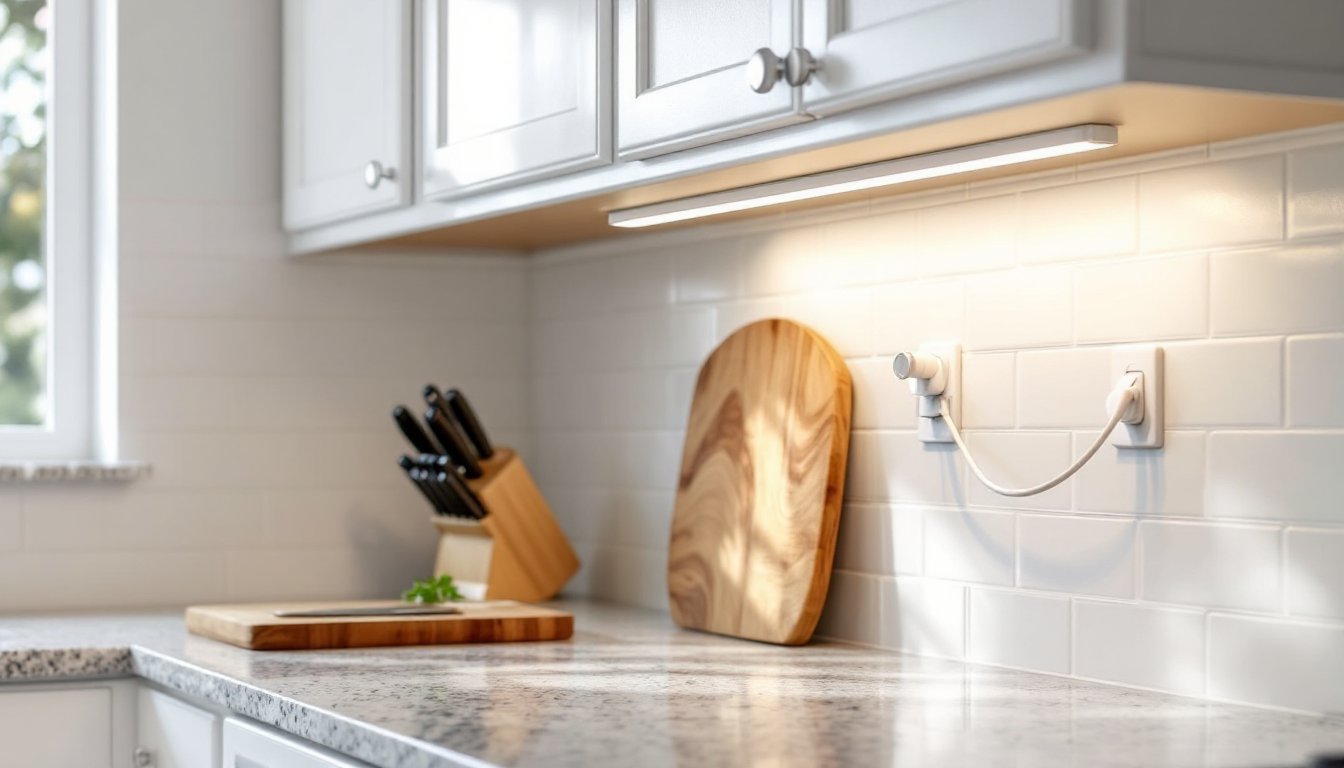
Plug-in under cabinet lighting transforms a dim kitchen workspace into a well-lit prep zone without the complexity of electrical rewiring. Unlike hardwired fixtures that require running cable through walls and connecting to junction boxes, plug-in options simply mount beneath cabinets and connect to a standard 120V outlet. This makes them ideal for renters, DIYers without electrical experience, or anyone looking for a quick lighting upgrade. The right plug-in setup can eliminate shadows on countertops, highlight backsplashes, and improve task visibility, all in an afternoon install with basic hand tools.
Table of Contents
ToggleKey Takeaways
- Plug-in under cabinet lighting eliminates the need for permits, electricians, or wall modifications, making it perfect for renters and DIYers who want a quick, affordable kitchen upgrade.
- LED strip lights, puck lights, and linear bars are the three main types of plug-in fixtures, each offering different coverage patterns—choose strips for continuous shadow-free light, pucks for highlighted zones, or bars for a finished look.
- Calculate your kitchen’s lighting needs at 300–500 lumens per linear foot of countertop, then match color temperature (2700K–3000K warm, 4000K–5000K cool) to your space and verify cord length reaches your nearest outlet.
- Proper surface preparation, strategic cord routing, and mounting fixtures 1–2 inches from the cabinet front are critical to preventing adhesive failure and ensuring light reaches your work surface instead of the backsplash.
- Plug-in under cabinet lighting costs $20–$60 per fixture and installs in 1–3 hours without visible wiring complications, though the trade-off is managing cords along cabinet undersides rather than concealing them entirely.
What Is Plug-In Under Cabinet Lighting?
Plug-in under cabinet lighting refers to any light fixture designed to mount beneath kitchen cabinets and draw power from a standard wall outlet rather than being hardwired into the home’s electrical system. These fixtures typically feature an integrated or detachable power cord ranging from 6 to 12 feet in length, ending in a standard two- or three-prong plug.
The fixtures themselves mount to the underside of wall cabinets using adhesive strips, screws, or mounting clips. Most units run on 120V AC power directly from the outlet, though some incorporate low-voltage transformers that convert household current to 12V or 24V DC for LED operation.
Common configurations include single fixtures, linked multi-light systems connected by jumper cables, and wireless setups where a plug-in transformer powers battery-free puck lights through electromagnetic induction. The defining characteristic is simple: no need to open walls, pull permits, or hire an electrician.
This category has expanded significantly with the adoption of LED technology. Where older fluorescent and xenon plug-in lights generated noticeable heat and required bulky transformers, modern LED plug-in fixtures remain cool to the touch and often integrate drivers directly into slim housings measuring less than 1 inch in profile.
Benefits of Choosing Plug-In Over Hardwired Options
No electrical permit or licensed electrician required. Plug-in lights don’t alter permanent wiring, so they fall outside the scope of most residential electrical codes. Homeowners can install them without scheduling inspections or paying professional labor rates, which often start at $75–$150 per hour depending on region.
Renters can take them when they move. Because plug-in fixtures don’t require modifying the landlord’s property beyond a few small screw holes (easily patched with wood filler), they’re a practical choice for anyone who doesn’t own the space. The entire system uninstalls in minutes.
Faster installation. A typical plug-in under cabinet lighting project takes 1 to 3 hours depending on the number of fixtures and whether the installer needs to drill cord management holes. Hardwired installations, by contrast, often require fishing cable through walls, cutting drywall access panels, and making connections inside junction boxes, work that can stretch across multiple days.
Easier troubleshooting and replacement. When a plug-in fixture fails, the homeowner unplugs it, removes the mounting hardware, and swaps in a new unit. Hardwired lights require shutting off the circuit breaker, testing for voltage, disconnecting wire nuts, and reconnecting the new fixture to the home’s electrical system.
Lower upfront cost. Plug-in LED strip kits start around $20 to $40 for basic 2-foot sections, while comparable hardwired LED bars run $50 to $100 per fixture before installation labor.
The trade-off is visible cords. Hardwired fixtures hide all wiring inside walls and cabinets, creating a seamless look. Plug-in setups require routing cords along the underside of cabinets, through drilled holes in cabinet sides, or down to nearby outlets, acceptable for most kitchens but less clean than concealed wiring.
Types of Plug-In Under Cabinet Lights
LED Strip Lights
LED strip lights consist of flexible circuit boards embedded with surface-mount diodes (SMDs), encased in a protective silicone or PVC coating. They’re sold in reels or pre-cut lengths, typically 1 to 6 feet, with adhesive backing for tool-free mounting.
Most plug-in LED strips operate on low-voltage DC power. A plug-in transformer (often called a driver or power supply) converts 120V AC household current to 12V or 24V DC. The strips connect to the driver via barrel connectors, and multiple strips can be linked in series using jumper cables, though each driver has a maximum wattage load (commonly 30W to 60W) that limits how many feet can be chained together.
Key specifications to check:
- Lumens per foot: Ranges from 150 to 500 lumens/foot. Task lighting for food prep generally requires 300+ lumens/foot.
- Color temperature: Measured in Kelvin. 2700K–3000K produces warm white light similar to incandescent bulbs: 4000K–5000K gives a cooler, daylight tone preferred for detailed work.
- CRI (Color Rendering Index): Ratings above 90 CRI render food colors accurately, important for cooking tasks.
- IP rating: IP65-rated strips resist splashes and grease, suitable for kitchen environments.
LED strips excel at providing continuous, shadow-free illumination across long countertop runs. They’re also the thinnest option, often under 0.5 inches thick, fitting cabinets with minimal clearance.
Puck Lights and Linear Bars
Puck lights are small, disc-shaped fixtures, typically 2.5 to 4 inches in diameter, that mount individually beneath cabinets. They create pools of light rather than continuous coverage. A three-puck kit might space fixtures 18 to 24 inches apart to balance brightness and avoid dark gaps.
Plug-in puck systems usually include a single transformer that powers multiple lights via interconnect cables. Dimming options and color temperature switching are common features in mid-range kits ($40–$80).
Puck lights work well for highlighting specific work zones or glass-front cabinets, but they can produce scalloped lighting patterns on backsplashes, an acceptable look for some, distracting for others.
Linear light bars are rigid fixtures ranging from 12 to 48 inches in length, housed in aluminum or plastic channels. They offer more focused output than strips and often include frosted diffusers to soften individual LED points into a uniform glow.
Plug-in linear bars typically feature built-in on/off switches, making them convenient for installations where the outlet isn’t easily accessible. Linkable models connect end-to-end with snap-together connectors, allowing coverage of extended countertop runs without visible gaps.
These bars mount with clips or screws and provide a cleaner, more finished appearance than adhesive LED strips. Expect to pay $25–$60 per fixture depending on length and lumen output.
How to Choose the Right Plug-In Under Cabinet Lighting
Measure the total linear footage of cabinets. Accurate dimensions determine how many fixtures or how much strip length is needed. For continuous coverage with LED strips, match the strip length to the cabinet run. For puck lights, plan on spacing them no more than their diameter apart to avoid dark spots.
Calculate required lumens. Kitchen task lighting typically needs 300 to 500 lumens per linear foot of countertop. A 6-foot counter would require 1,800 to 3,000 total lumens. Check product specs for lumens per foot (strips) or lumens per fixture (pucks and bars). Underlighting is a common mistake, err toward higher output if uncertain.
Match color temperature to the space. Warm white (2700K–3000K) complements wood cabinetry and creates a cozy feel but can make food look slightly yellow. Neutral white (3500K–4000K) balances warmth and clarity. Cool white (5000K+) enhances contrast and detail but may feel clinical in traditional kitchens. Some plug-in systems offer selectable color temps via a switch or remote.
Check cord length and outlet access. Most plug-in lights include 6-foot cords. If the nearest outlet is farther away, an extension cord becomes necessary, choose one rated for the fixture’s wattage and avoid running cords across walkways or behind appliances that generate heat. Some installers drill 1-inch holes through cabinet sides or backs to route cords discreetly toward outlets.
Consider dimming capability. Plug-in dimmers are available as inline cord modules or wall-mounted switches that intercept the power cord. Not all LED fixtures are dimmable, verify compatibility before purchasing a dimmer to avoid flickering or damage.
Assess mounting constraints. Cabinets with less than 0.75 inches of clearance between the cabinet bottom and backsplash may not accommodate rigid linear bars. LED strips are the slimmest option. Also confirm whether the cabinet material (particleboard, plywood, solid wood) will accept screws or if adhesive-only mounting is required.
Evaluate control options. Basic models use an inline rocker switch on the cord. Mid-range units add touch sensors, motion activation, or wireless remotes. Higher-end systems integrate with smart home platforms via Wi-Fi or Bluetooth, allowing app control and scheduling, useful for automating lighting routines but not essential for most DIY installs.
Installation Tips for Plug-In Under Cabinet Lights
Prep the surface. Wipe cabinet undersides with degreaser or rubbing alcohol to remove cooking oils and dust. Adhesive-backed strips and pucks won’t bond to dirty surfaces. Let the surface dry completely before mounting.
Plan cord routing before mounting fixtures. Lay out the lights and cords on the counter to visualize the path to the outlet. Minimize visible cord runs by routing them along the back edge of the cabinet underside, through drilled holes in cabinet sides, or behind decorative molding. Avoid placing cords where they’ll contact the backsplash or interfere with small appliances.
Drill discreet wire pass-throughs when needed. A 3/4-inch spade bit or hole saw creates openings large enough for most plugs and connectors to pass through cabinet sides. Drill from the inside face to avoid splintering the exterior veneer. Deburr holes with sandpaper.
Mount lights toward the front of the cabinet. Positioning fixtures 1 to 2 inches from the front edge directs light onto the work surface rather than down the backsplash. Mounting too far back creates shadows from items on the counter.
Use screws on particleboard or MDF cabinets. Adhesive alone may fail on these surfaces, especially in humid environments. Pre-drill 1/16-inch pilot holes to prevent splitting, then secure with #6 x 0.5-inch pan-head screws. For solid wood or plywood, adhesive typically holds, but screws add insurance.
Link multiple fixtures carefully. When connecting LED strips or puck lights in series, observe polarity markings (+ and – symbols or red and black wires). Reversed connections prevent the lights from functioning and may damage low-voltage drivers. Keep total connected wattage below the driver’s rated capacity.
Test before final mounting. Plug in the system and verify all fixtures illuminate evenly. Check for flickering, dim spots, or non-responsive sections. It’s easier to troubleshoot loose connections before securing everything permanently.
Secure cords with clips or staples. Adhesive cable clips or insulated staples (not metal staples that can pierce insulation) keep cords tidy along cabinet undersides. Space clips every 12 to 18 inches. Never staple directly through the cord jacket.
Safety note: Wear safety glasses when drilling overhead. Keep cords away from heat sources like stovetops or toaster slots. If the outlet used for the lights is on a GFCI circuit (common near sinks), occasional nuisance tripping may occur with some LED drivers, test after installation and relocate to a standard outlet if necessary.
If the installation involves adding a new outlet closer to the cabinets, that’s hardwired electrical work requiring a permit and a licensed electrician in most jurisdictions. Stick to existing outlets to keep the project truly plug-in.